 20 Mar 2026
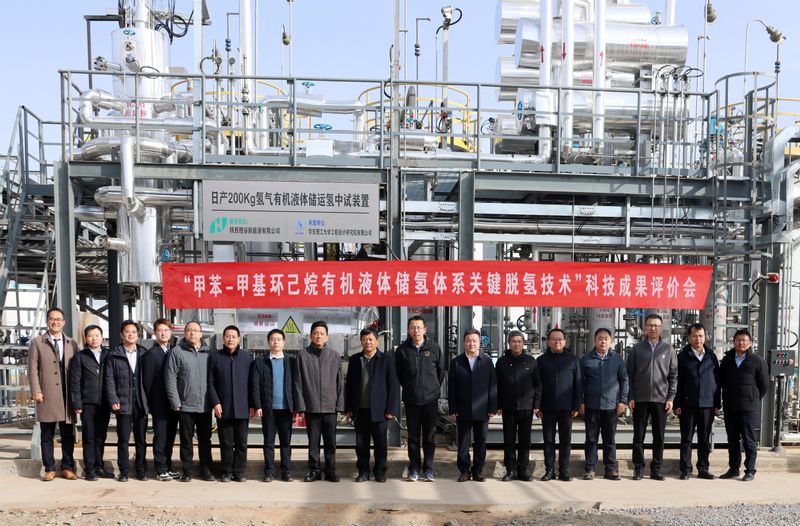
Recently, the Key Dehydrogenation Technology for the Toluene-Methylcyclohexane Liquid Organic Hydrogen Storage System, jointly developed by the team led by Professor Yong Guo from ECUST and Shihezi University in collaboration with Shaanxi Ligu Renewable Energy Co., Ltd., has passed a scientific and technological achievement appraisal.
The evaluation meeting was held in Yulin, Shaanxi Province, and organized by the China Petroleum and Chemical Industry Federation. A panel of seven experts from leading universities and research institutes participated in the review. Weihong Zhu, Academician of the Chinese Academy of Sciences and Vice President of ECUST, attended the meeting.
Zhu noted that hydrogen energy is a key direction for the green-oriented transition of energy, while bottlenecks in storage and transportation remain a major constraint on its large-scale development. The toluene–methylcyclohexane liquid organic hydrogen storage technology, featuring high hydrogen storage density, high safety, and compatibility with existing petrochemical logistics systems, etc., has become a major research focus.
Led by Professor Yong Guo, the project fully leverages the university’s disciplinary strengths and promotes deep research collaboration between industry and university, achieving breakthroughs in key dehydrogenation technology and laying a solid foundation for industrial application.
After conducting an on-site inspection of the pilot unit and reviewing the relevant documentation, the expert panel unanimously agreed that the project has established China’s first 200 kg H₂/day methylcyclohexane dehydrogenation pilot unit. The newly developed catalyst demonstrates excellent performance, and the unit operates stably with key indicators exceeding design values, providing a feasible solution for the safe storage and transportation of green hydrogen on a large scale. The evaluation committee approved the achievement and concluded that it, on the whole, has reached an internationally advanced level.
The successful convening of the evaluation meeting marks a key step in advancing the technology from laboratory research to industrial engineering. The achievement aligns with China’s hydrogen energy development and carbon peaking and carbon neutrality goals, and is expected to help overcome long-distance hydrogen storage and transportation challenges, support the West-to-East Hydrogen Transmission Initiative and offer broad application prospects.