 12 Mar 2026
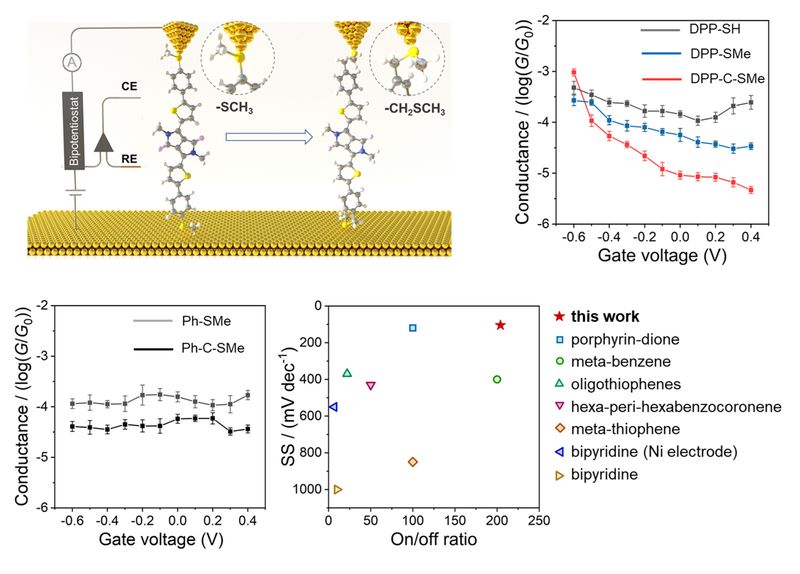
Recently, a research team led by Professor Hongxiang Li from the Feringa Nobel Prize Scientist Joint Research Center, School of Chemistry and Molecular Engineering, ECUST, reported new progress in single-molecule electrochemical transistors in the Journal of the American Chemical Society. The study, titled “High-Performance Electrochemically Gated Single-Molecule Transistor Enabled by Interfacial Engineering”, demonstrated the construction of high-performance single-molecule electrochemical transistors through a precise interfacial engineering strategy, providing a new approach for the high-performance development of molecular electronic devices.
As a core device in molecular electronics, single-molecule transistors have long faced challenges in performance improvement, including limited on/off ratios and relatively high static power consumption. To address these issues, the research team proposed an innovative molecular design strategy that integrates a narrow-bandgap molecular backbone with interfacial decoupling. Through precise regulation of the alignment between the energy levels of molecular conducting orbitals and the Fermi level of electrodes, as well as the coupling strength at the molecule-electrode interface, the team significantly enhanced the gating efficiency and switching performance of the transistors, establishing a new design paradigm for the high-performance molecular electronic devices.
This paper was completed with ECUST as the sole corresponding affiliation. Postdoctoral Researcher Rui Wang from the School of Chemistry is the first author, and Professor Hongxiang Li is the corresponding author. The research was carried out under the guidance of Academician He Tian, and supported by the National Natural Science Foundation of China, the Science and Technology Commission of Shanghai Municipality, and the Fundamental Research Funds for the Central Universities.