 09 Mar 2026
Recently, a research team led by Professor Feng Gao from the School of Pharmacy, ECUST reported new progress in nucleic acid delivery and colitis therapy in Chemical Engineering Journal. Building on their previous work on antisense oligonucleotide (ASO) zinc-coordinated nanozymes and oral polymeric materials, the team developed an oral gold-conjugated cerium-based nanoplatform, successfully addressing key challenges in the efficient condensation, delivery, and transfection of antisense oligonucleotides.
By integrating the platform’s intrinsic ability to regulate free radicals, NADPH, and lactate, the study established a multi-modal therapeutic strategy targeting the major pathological features of inflammatory bowel disease (IBD), including intestinal inflammation activation, barrier disruption, immune and microbiota dysbiosis, fibrosis, and disease recurrence. The related findings were published under the title “Oral cerium-based nanoplatform conjugated with gold to load anti-miR-301a for pH-transited multi-modal therapy of inflammatory bowel disease”.
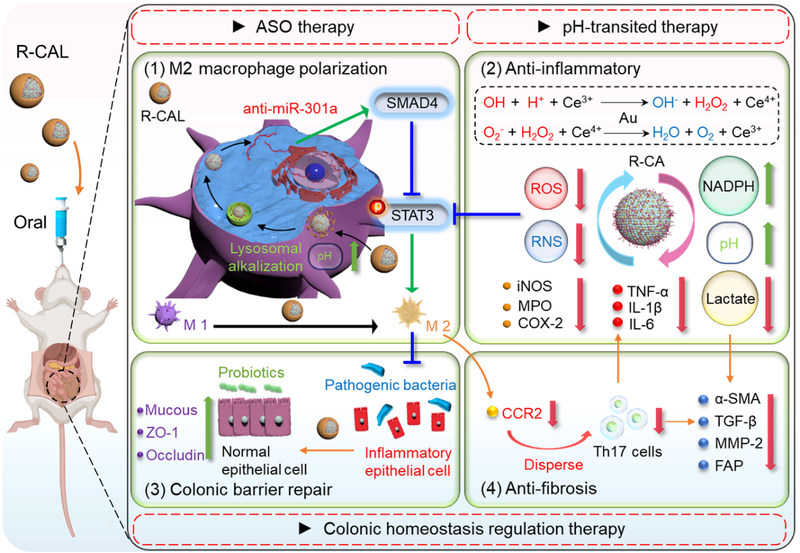
As a type of ASO therapy, anti-miR-301a effectively alleviates the progression of IBD. However, its therapeutic performance is limited by insufficient gene condensation and low transfection efficiency. Moreover, it cannot independently resolve complex IBD-related disorders such as inflammatory microenvironment imbalance and fibrosis, highlighting the need for combinatorial multi-modal therapies to enhance its clinical potential.
Doctoral students Jiafeng Zou and Xi’er Pan, and master’s student Qingdong Ji from the School of Pharmacy are the co-first authors of this paper. Professor Feng Gao and Postdoctoral Researcher Kun Jiang are the corresponding authors.