 17 Mar 2026
Recently, a research team from the R&D Center for Separation and Extraction Technology in Fermentation Industry, School of Biotechnology, ECUST, reported new research achievements in Green Chemistry, a leading international journal in the field of chemistry.
The study, titled “Novel iterative genome mining and engineering of a bifunctional KvVDH enable selective production of furan carboxylic acids from high-concentration 5-hydroxymethylfurfural,” focuses on the discovery and engineering of bifunctional HMF oxidases and the efficient biomanufacturing of FDCA This study established a highly efficient and selective biocatalytic platform, providing a promising approach for the selective conversion of high-concentration HMF into various value-added furan carboxylic acids.
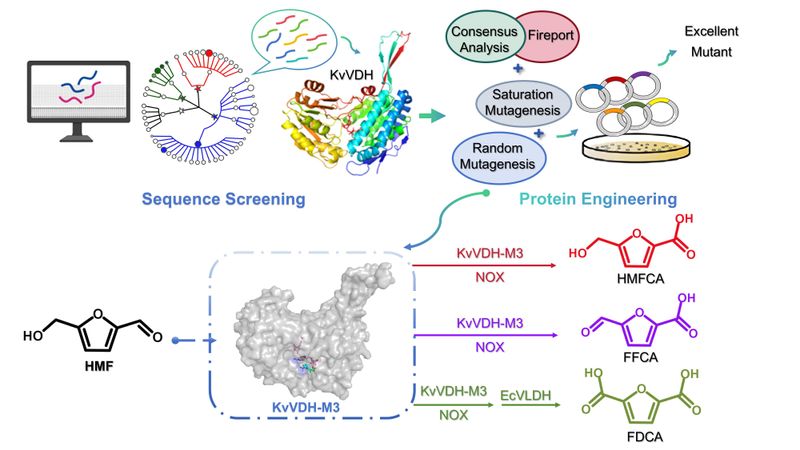
The synthesis and catalytic upgrading of HMF are regarded as pivotal for the transition from a fossil-based economy to a sustainable bio-based economy. The shift towards bio-based polymers requires renewable alternatives to terephthalic acid used in PET production, among which FDCA stands out as a key monomer for polyethylene furanoate (PEF).
To expand enzymatic synthesis pathways of furan carboxylic acids, this study developed a molecular probe- and function-mediated iterative genome mining strategy, which increased the discovery rate of functional enzymes to 32.1 percent, approximately three times higher than that of conventional homology-based screening methods The developed biocatalytic process exhibits excellent selectivity and high yields under high substrate concentrations, highlighting its potential for the green production of bio-based chemicals.
Professor Zhao and Associate Professor Deng from the School of Biotechnology are the co-corresponding authors, and doctoral student Yanan Cui is the first author. This work was supported by the National Key R&D Program of China, the National Natural Science Foundation of China, the 2024 Shanghai Science and Technology Innovation Action Plan (Synthetic Biology Program), and the Exploratory Project of ECUST-Jingbo Joint Research Institute for Applied Technology.