 16 Mar 2026
Recently, the team led by Professor Lixin Zhang and Dr. Yongtao Xie at the State Key Laboratory of Bioreactor Engineering, ECUST, has achieved an important breakthrough in the field of enzyme catalysis. Their research was published in the Journal of the American Chemical Society under the title “Enzyme-Catalyzed Intramolecular C-C Coupling Transformation of Nitriles”. The core innovation of this research can be summarized as teaching an enzyme a new skill.
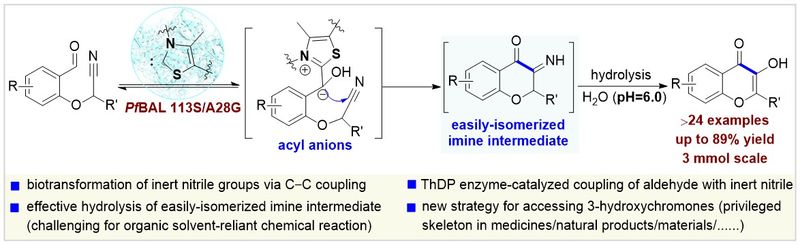
The molecular frameworks of many drugs and natural products rely on carbon–carbon (C–C) bonds. In biocatalysis, thiamine diphosphate-dependent enzymes are skilled at forming carbon–carbon (C–C) bonds using aldehyde groups, but they cannot act on inert nitriles. This study successfully engineered such an enzyme to achieve, for the first time, the enzyme-catalyzed intramolecular addition of aldehydes to nitriles, thereby extending the C–C bond-forming capability of this enzyme class to inert nitrile systems.
The final product of the reaction is 3-hydroxychromones, the core structural unit of flavonols. Flavonols are considered active components responsible for many health benefits. Traditional synthetic methods for these molecules are often complex and rely on harmful oxidants. This study opens a green pathway: the reaction proceeds efficiently in the aqueous phase under mild conditions, without the need for added oxidants. This not only broadens the application scope of enzyme catalysis, but also provides a new tool for the development of flavanol-based therapeutics.
The project was mainly carried out by Chaonan Zhu, a Ph.D. candidate at ECUST. The corresponding authors are Professor Lixin Zhang and Associate Professor Yongtao Xie. The research benefited from the guidance of Professor Yonggui Chi from Nanyang Technological University and Guizhou University, and Professor Mengchun Ye from Nankai University. It was also supported by the National Natural Science Foundation of China, the National Key Research and Development Program of China, and the Fundamental Research Funds for Central Universities.