 25 Mar 2026
A research team led by Professors Lingzhi Wang and Jinlong Zhang from the School of Chemistry and Molecular Engineering, ECUST, has developed a highly efficient, sustainable method for the photocatalytic selective dehydrogenation of ethane. The research, titled “Site-defined Cu-O ensembles enable hydrogen-conserving light-driven ethane upgrading”, was recently published in Nature Communications.
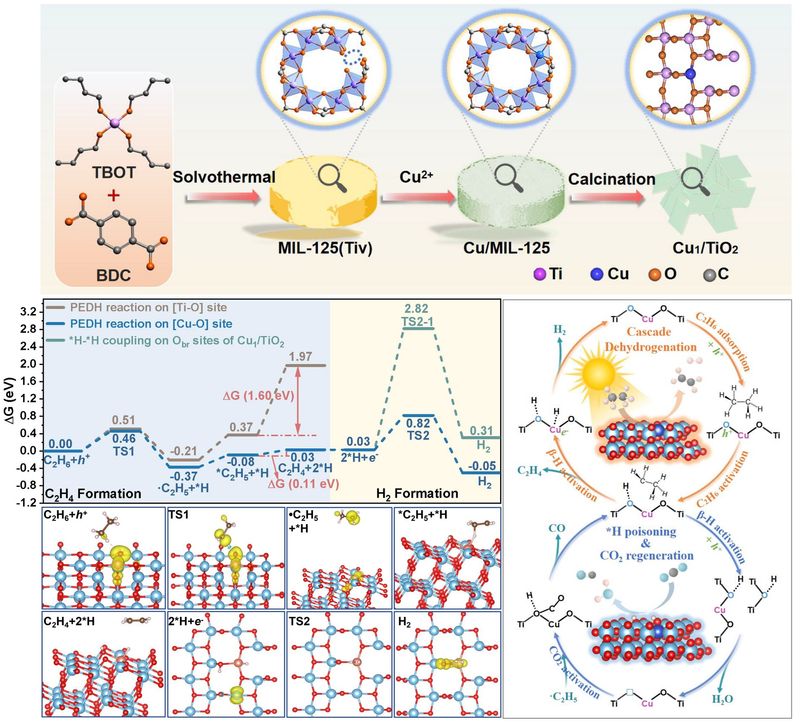
The solar-driven photocatalytic dehydrogenation of ethane utilizes the redox capabilities of photogenerated carriers to activate C–H bonds and produce ethylene under mild conditions. This offers a greener alternative to traditional thermal catalysis, which suffers from extreme energy consumption, over-dehydrogenation, and rapid catalyst deactivation. However, controlling the precise evolution of active species and managing surface hydrogen to prevent catalyst poisoning have remained major scientific challenges.
To address these bottlenecks, the team designed a highly specific photocatalyst featuring atomically defined [Cu–O] adjacent ensembles. In this synergistic system, the introduction of copper atoms forces photogenerated holes to localize efficiently at adjacent bridging oxygen sites. This initiated the first crucial step: the activation of the C–H bond in ethane. Subsequently, the copper sites facilitated the activation of β-hydrogen in the *C2H5 intermediates and the generation of H2.
This precise atomic design created a highly directional “hydrogen-conserving” pathway that couples hole management with stepwise dehydrogenation. Furthermore, to combat the issue of surface hydrogen failing to desorb and poisoning the catalyst, the researchers ingeniously introduced a CO2 “self-cleaning” cycle. This cycle promotes the dynamic removal of residual hydrogen and ensures the continuous regeneration of the [Cu–O] active sites. Supported by theoretical calculations of excited-state and ground-state reaction pathways, the study provided a deep, atomic-level understanding of photogenerated carrier localization. It established a robust theoretical foundation for the kinetic nature of photocatalytic alkane activation.
Professor Lingzhi Wang and Professor Xiaoming Cao serve as the co-corresponding authors of the paper, with doctoral candidates Qingqing Zhang and Cong Liu as the co-first authors.
This research was supported by the State Key Laboratory of Green Chemical Engineering and Industrial Catalysis, the Shanghai Engineering Research Center of Multi-media Environmental Catalysis and Resource Recovery, the Feringa Nobel Prize Scientist Joint Research Center, the National Key R&D Program of China, the Shanghai Engineering Research Center of Multi-media Environmental Catalysis and Resource Recovery, etc.