 09 Mar 2026
Recently, the research team led by Professor Fuzhen Xuan from the School of Mechanical and Power Engineering has made important advances in the field of high-performance MEMS hydrogen (H₂) sensors. The paper, Interfacial stress decoupling enables stable palladium-based hydrogen sensing, has been published online in the academic journal Nature Communications.
By introducing a dithiol-based self-assembled monolayer (SAM) for interfacial engineering, this study proposes a novel floating-structure hydrogen sensor architecture design, providing a new solution for highly reliable and sensitive hydrogen detection at room-temperature.
As a key component of clean energy, hydrogen holds broad application prospects in the energy, chemical, and transportation sectors. However, the small molecular size, fast diffusion, and flammable and explosive nature of hydrogen impose extremely high requirements on the sensitivity, stability, and durability of sensors. Palladium (Pd), with its excellent selectivity toward hydrogen, is widely used as a hydrogen-sensitive material.
Nevertheless, the current fabrication of Pd-based hydrogen sensors still faces critical bottlenecks: the intrinsic lattice mismatch between the Pd sensing layer and the supporting substrate tends to induce localized stress; meanwhile, repeated hydrogen absorption and desorption in Pd exacerbates stress accumulation, eventually leading to delamination of the sensing layer and degradation of sensing performance, which severely restricts their long-term reliable operation.
To address this critical issue, the research team proposed an interfacial stress-decoupling strategy by implanting a dithiol-based SAM, constructing a vertically stacked floating-structure Pd-based hydrogen sensor architecture. In this design, the dithiol-based SAM is introduced between the Pd sensing layer and the Au electrode, acting not only as an efficient electron transport interface but also as a flexible mechanical buffer layer. It can effectively alleviate the localized stress caused by lattice mismatch while suppressing substrate clamping effects, thereby significantly improving the mechanical stability of the Pd layer and accelerating H₂ absorption kinetics. Experimental results demonstrate that the sensor exhibits outstanding performance: it achieves an ultrasensitive detection limit of 1 ppm at room temperature, enables stable detection of hydrogen concentrations up to 4 vol%, and maintains excellent stability and repeatability during cyclic testing.
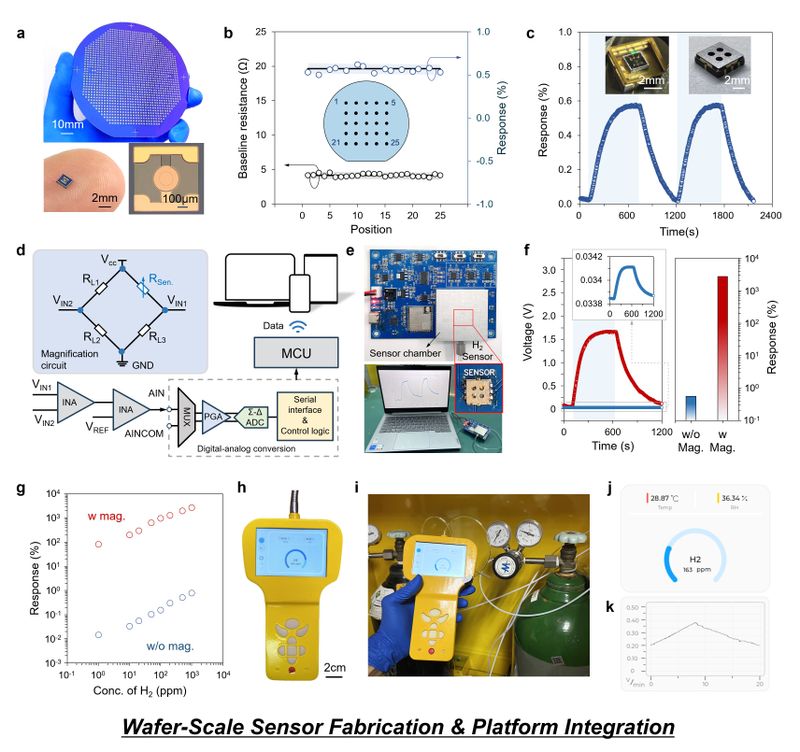
Furthermore, the research team has successfully realized the smooth transition of this floating-structure hydrogen sensor from laboratory prototypes to wafer-scale device fabrication, verifying its favorable process compatibility and scalable manufacturing potential. Based on standard micro- and nanofabrication processes, the sensors can be uniformly fabricated on 4-inch wafers and successfully integrated into a portable platform for real-time monitoring and early warning of hydrogen leaks.
This achievement indicates that the proposed SAM interfacial stress-engineering approach not only carries significant implications for fundamental research but also demonstrates clear feasibility in engineering applications. The approach overcomes the stability bottleneck of traditional Pd-based hydrogen sensors, which are prone to failure under high-concentration and long-term operation conditions, providing a general design strategy for constructing high-performance, highly reliable, and scalable molecular and gas sensors, and is expected to accelerate the development of hydrogen sensing technology toward large-scale, practical, and systematic applications.
ECUST is the sole corresponding institution of this paper. Rui Gao, a master’s graduate from ECUST, is the first author, and Professor Fuzhen Xuan and Associate Professor Guozhu Zhang from the School of Mechanical and Power Engineering are the corresponding authors.
This work was supported by the Science Fund for Creative Research Groups of the National Natural Science Foundation of China, the National Natural Science Foundation of China, etc.