 11 Mar 2026
Recently, the research group led by Professor Jianhua Fan from the School of Biotechnology has published a research paper entitled “Genome-wide hypermutation-engineered Synechocystis sp. PCC 6803 reveals membrane-mediated triclosan resistance” in Plant Physiology. Founded in January 1926 and sponsored by the American Society of Plant Biologists (ASPB), Plant Physiology is one of the oldest and most influential journals in plant science.
In aquatic environments, broad-spectrum antimicrobials are widely detected due to their extensive use in daily chemical products and incomplete removal during wastewater treatment. They may exert persistent selective pressure that drives the evolution of antimicrobial tolerance and resistance in environmental microorganisms.
As key primary producers in aquatic ecosystems and classic photosynthetic model organisms, cyanobacteria are not only direct recipients of pollution stress but also serve as ideal model systems for understanding how photosynthetic organisms respond to chemical stress. However, traditional adaptive laboratory evolution (ALE) is time-consuming and characterized by high background mutations noise, often making it difficult to efficiently identify key tolerance genes and core mechanisms within a controllable timeframe.
Using the photosynthetic model cyanobacterium Synechocystis sp. PCC 6803 as the model organism, this study innovatively constructed a genome-wide hypermutation-directed evolution platform for screening key loci, identification of determinants of pollutant tolerance. Based on genomic, structural and physiological studies, a multi-layered tolerance mechanism of cyanobacteria in response to triclosan (TCS) stress was proposed and systematically elucidated for the first time. These findings provide a new methodological framework for understanding the evolution of antimicrobial resistance driven by antimicrobials in aquatic environments and for targeted prevention and control.
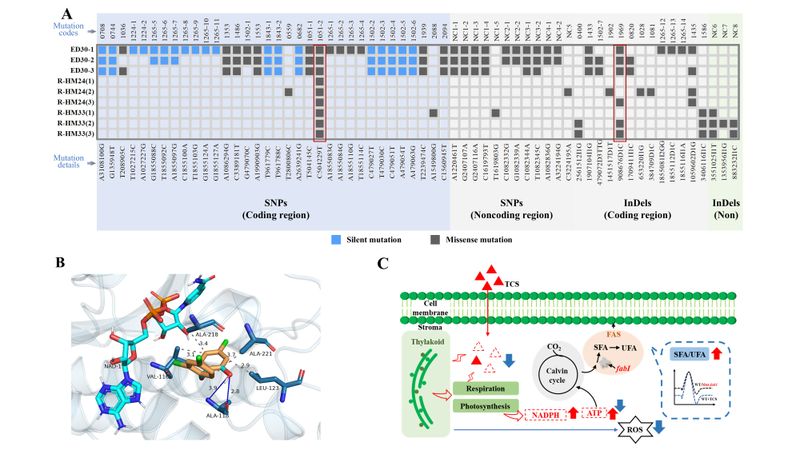
a) Visualization of whole-genome resequencing results; the red boxes indicate the key high-frequency mutation sites. b) Docking pose of TCS in the A116V mutant fabI-NAD + complex. c) Analysis of the tolerance mechanism of Mut-fabI to TCS.
This study has achieved the rapid localization and mechanistic decoding of determinants of pollutant tolerance in cyanobacteria, and revealed a membrane-mediated tolerance mechanism centered on membrane lipid remodeling, starting from mutations in the fabI target. It provides actionable engineering and mechanistic clues for subsequent pollution control and antimicrobial emission management.
Ping Wu and Kaixin Wei, PhD candidates at ECUST, are the co-first authors of the paper. Professor Jianhua Fan, affiliated with ECUST and Shihezi University, is the corresponding author. The research was supported by the National Key R&D Program of China (Synthetic Biology Special Project), Shanghai Science and Technology Innovation Action Plan, Shanghai Natural Science Foundation, Xinjiang Tianchi Talents Program, and other projects.