 06 Mar 2026
A research team led by Professor Yongdi Liu and Associate Professor Liang Zhou from the School of Resources and Environmental Engineering at East China University of Science and Technology has recently reported new progress in advanced oxidation technology in the leading environmental journal Water Research.
The study, titled “Tailoring COFs for highly selective generation of singlet oxygen to boost antibiotic removal: Spatial regulation of PMS and photogenerated carriers,” proposed a novel nonradical pathway for the highly selective generation of singlet oxygen. This mechanism was based on the direct oxidation of peroxymonosulfate by photogenerated holes and demonstrates remarkable efficiency in pollutant photodegradation, offering a new strategy for advanced water treatment.
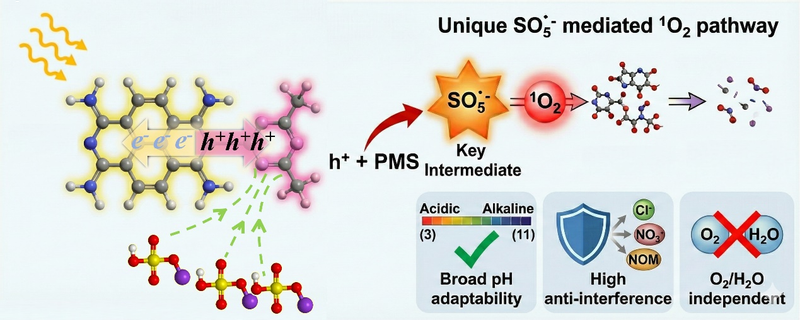
The accumulation of antibiotics such as levofloxacin in aquatic environments has become a global concern. Although peroxymonosulfate-based advanced oxidation processes are widely used for pollutant removal, conventional radical pathways suffer from short lifetimes, sensitivity to water matrices, and low oxidant utilization efficiency. In contrast, singlet oxygen is a nonradical reactive oxygen species with higher selectivity and environmental adaptability, but its generation typically relies on indirect pathways that involve additional reactants and energy loss.
In this work, the team introduced a direct hole-driven activation mechanism in a covalent organic framework and peroxymonosulfate system. By designing a triazine-based COF catalyst, the researchers achieved the integration of hole capture sites and selective adsorption sites for peroxymonosulfate. This design enabled the in situ oxidation of adsorbed molecules and directs the reaction toward a nonradical pathway, achieving a singlet oxygen selectivity of up to 99.5 percent.
To evaluate practical applicability, a continuous flow photoreactor was constructed. The system maintained over 90 percent removal efficiency of levofloxacin during 10 hours of continuous operation, demonstrating excellent stability and resistance to interference.
The study provided new insights into the molecular-level regulation of catalytic processes and offered a promising approach for efficient treatment of complex organic wastewater. The first author of the paper is doctoral student Yangjie Wu. Professors Yongdi Liu and Liang Zhou are the corresponding authors. The research was supported by the National Natural Science Foundation of China.