 31 Mar 2026
Recently, Le Zhang, an undergraduate majoring in Landscape Architecture from the School of Art Design and Media at ECUST, traveled to Turin, Italy to participate in the Global Youth Forum hosted by the International Training Centre of the International Labour Organization (ITCILO).
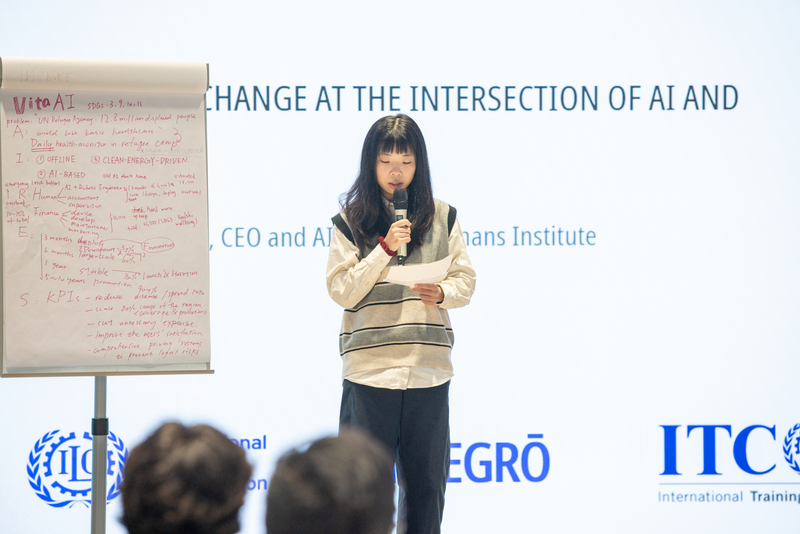
The program adopted a highly selective dual-track admission system combining open global applications and institutional nominations, with only around 20 to 30 participants admitted worldwide. Zhang’s selection marked not only a significant milestone in her personal development, but also a vivid example of ECUST’s design education engaging with global challenges.
Supported by the university with its long-standing emphasis on interdisciplinary training, industry-academia integration, and international outlook, Zhang demonstrated strong professional competence and creative thinking on an international platform focused on emerging technologies and sustainable development.
In her own words, Zhang shared her reflections on this transformative experience below.
From “Distant Concepts” to “Tools in My Toolbox”
Before attending the forum, my understanding of emerging technologies was quite general. I knew artificial intelligence was rapidly developing, and quantum computing sounded impressive, but they all felt distant from landscape architecture.
However, the interdisciplinary approach adopted by ECUST encouraged us to think beyond the boundaries of a single discipline. With that mindset, I joined the forum with openness and curiosity. Over the two-week program, my perception of how technology and design intersect was completely reshaped.
The forum focused on the intersection of emerging technologies and sustainable development, bringing together young participants from around the world to explore artificial intelligence, quantum computing, biotechnology, and neurotechnology. It also examined the United Nations Sustainable Development Goals and encouraged us to think about how these technologies can serve as accelerators for social progress, from formalizing employment to building greener economies.
During a case discussion on air pollution in Ulaanbaatar, I realized that environmental challenges are deeply intertwined with cultural transitions, energy poverty, and urban planning issues. Design alone cannot solve such complex problems. Artificial intelligence helps predict pollution patterns, while biotechnology can convert waste into energy.
At that moment, I understood that emerging technologies are not distant concepts. They can become new tools in our professional toolbox.
We also visited the quantum computing laboratory at Politecnico di Torino, where I experienced firsthand the real-world potential of these technologies in fields such as biomedicine, climate science, and finance.
One idea from the forum stayed with me: meaningful projects begin with real human needs, not with technology searching for problems.
From Design Thinking to the Global Stage
In the final project presentation, my team developed a proposal titled “BIO-LOOP: From Waste to Warmth.”
The project integrates artificial intelligence, biotechnology, and robotics to convert livestock waste into clean energy and sustainable products. It reflects both my academic training and ECUST’s broader commitment to addressing global sustainability challenges through design.
Presenting this proposal on an international platform allowed us to showcase the creativity, responsibility, and problem-solving capacity of young Chinese designers. The project received positive feedback from both mentors and peers.
Stepping Outward, Thinking Globally
For me, the most valuable takeaway from this experience was not mastering a specific technology, but developing the ability to engage in meaningful dialogue.
We do not need to become experts in every emerging technology, but we do need to understand how these technologies work, where their boundaries lie, and how they can be meaningfully integrated into our own disciplines.
Looking back, I would share a few suggestions for future applicants:
Connect your academic background with global issues such as sustainable development.
Demonstrate interdisciplinary thinking, especially at the intersection of technology and social impact.
Stay open-minded in cross-cultural collaboration and learn to build consensus across differences.
I am deeply grateful to the university for providing this opportunity. It allowed me to bring ECUST’s design philosophy to a global platform and to share the creativity of Chinese youth with the world.
I hope more students will step beyond campus boundaries, engage with global conversations, and explore broader possibilities for learning and growth.