 01 Apr 2026
Recently, the research team led by Academician He Tian and Professor Xiang Ma from the School of Chemistry and Molecular Engineering, ECUST, made new progress in the study of dual-component organic afterglow materials. The related research was published in Angewandte Chemie International Edition (Angew. Chem. Int. Ed., 2026, e5554671) under the title “Pseudo-Homologue Doping Strategy for Afterglow Materials”.
Organic afterglow materials have attracted extensive attention due to their unique delayed luminescence properties. However, recent studies have revealed that the emission of many materials previously considered to exhibit intrinsic afterglow is closely related to trace impurities in the material system.
Based on this fact, a new strategy has been developed in previous studies to construct afterglow materials by doping a small number of “impurities” into a host compound. Nevertheless, the screening of hosts and dopants for such dual-component doping strategies usually relies on random experiments, lacking an intuitive and efficient screening method.
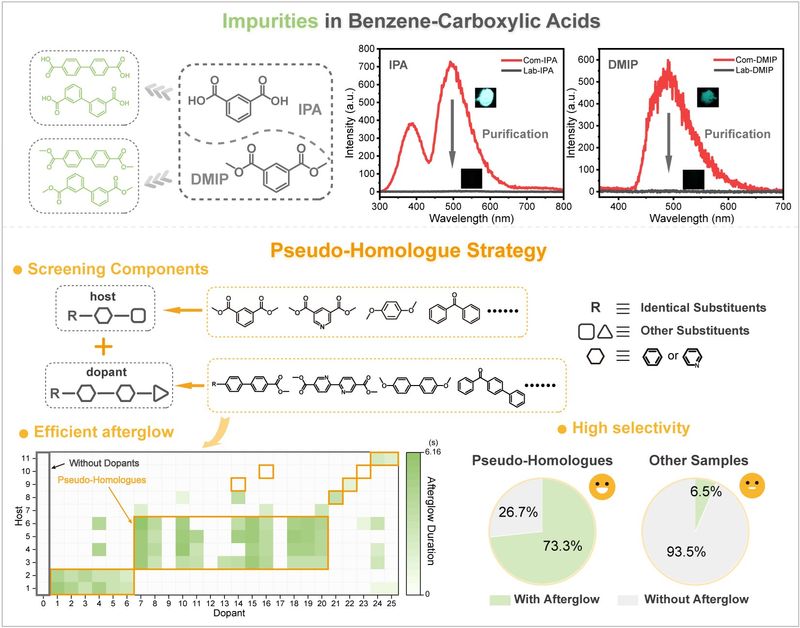
Building on long-term research on benzene-carboxylic acid (BCA) derivatives, the research team employed purification and analytical techniques such as vacuum sublimation, column chromatography, and high-performance liquid chromatography (HPLC) to demonstrate that their afterglow is not an inherent photophysical property, but originates from trace impurities.
Systematic characterization confirmed that these trace impurities are biphenyl carboxylic acid and its derivatives. Notably, one of these impurities can induce detectable phosphorescence even at a doping ratio as low as 0.1 ppm (molar ratio). Inspired by the structural similarity between the impurities and the main component (BCAs), the team developed a pseudo-homologue strategy to screen suitable hosts and dopants for constructing organic afterglow materials.
Guided by this strategy, the team found that substituting different substituents on the impurity structure, or even replacing the benzene ring with a pyridine ring as the dopant, can also induce afterglow in BCA derivatives. Furthermore, the team constructed 275 doped samples with diverse molecular backbones and substituents. Samples conforming to the pseudo-homologue characteristics exhibited a high proportion of afterglow (73.3%) compared to other samples (6.5%). This structural model offers new perspectives for the construction of dual-component afterglow materials.
Professor Xiang Ma and Distinguished Associate Research Fellow Liangwei Ma are co-corresponding authors of the paper, and doctoral student Jiayu Wang is the first author. The research was conducted under the guidance of Academician He Tian and was supported by the Basic Science Center Program and the National Science Fund for Distinguished Young Scholars of the National Natural Science Foundation of China (NSFC).