 06 Apr 2026
Recently, a research team led by Professor Fu-Zhen Xuan from the School of Mechanical and Power Engineering at ECUST published a paper titled “Shear properties and stable wrinkle resistance in 2D Ti3C2Tx MXene monolayers” in Nature Communications.
The study observed the damage origins of two-dimensional materials under shear loading at the atomic scale for the first time through scanning transmission electron microscopy (STEM), molecular dynamics (MD) simulations, and first-principles calculations. This research challenges the traditional understanding of shear instability in two-dimensional materials.
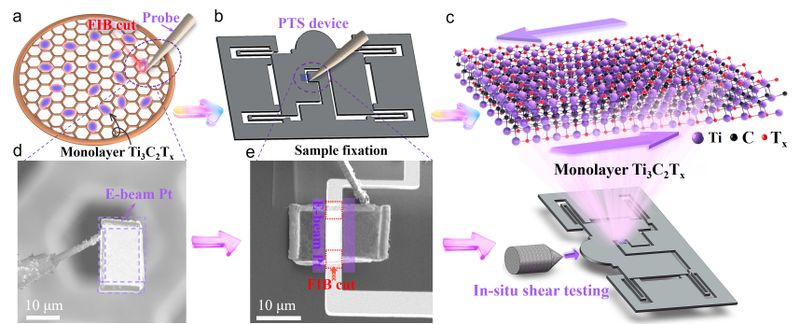
The team employed the “push-to-shear” (PTS) strategy to apply in-plane shear loading. They found that, contrary to the expected ultra-low shear performance and wrinkle instability of traditional 2D materials, the monolayer Ti3C2Tx nanosheets exhibited a shear modulus of 278.8 ± 7.4 GPa, approximately four times that of monolayer graphene.
Through in situ observations and molecular dynamics simulations, it was discovered that the damage did not occur in the form of overall instability, but manifested as localized and progressive non-uniform deformation accumulation. STEM directly observed the localized damage on the surface of the monolayer Ti3C2Tx nanosheets, which did not evolve into overall periodic wrinkles. First-principles calculations indicated that the strong bonding between the atomic layers of Ti3C2Tx effectively redistributes localized stress, preventing macroscopic wrinkles triggered by large-scale energy accumulation.
The study reveals the microscopic mechanism behind the high shear modulus and stable out-of-plane wrinkle resistance of Ti3C2Tx It provides scientific understanding for the optimal design, structural integrity, and stability of functional devices based on two-dimensional materials. Furthermore, the research offers atomic-scale evidence for understanding damage origin characteristics, such as damage localization and strain accumulation in structural materials.
ECUST is the sole corresponding institution for this research. Professor Mingliang Zhu, Professor Yabin Yan, Professor Bowei Zhang, and Professor Fu-Zhen Xuan from the School of Mechanical and Power Engineering at ECUST are the co-corresponding authors. Doctoral candidates Chao Rong, Ting Su, and Tianhao Yu from the School of Mechanical and Power Engineering at ECUST serve as the co-first authors.
The research was supported by the Innovative Research Group Project of the National Natural Science Foundation of China, the National Science Fund for Excellent Young Scholars, and the General Program of the National Natural Science Foundation of China, as well as the Shanghai Pilot Program for Basic Research, among other programs.