 05 May 2026
Recently, a collaborative research team led by Professor Xiang Ma, Professor Dawei Li and Distinguished Associate Researcher Binbin Chen from the School of Chemistry and Molecular Engineering of ECUST has made important progress in the research of photoactivated room-temperature phosphorescence (pRTP) materials. The relevant research results, titled “Engineering Ultrahigh‐Contrast Photoactivated Room‐Temperature Phosphorescence With a Robust and Universal Ureido‐Functionalized Siloxane Network”, have been published in Angewandte Chemie International Edition (2026, e7684555).
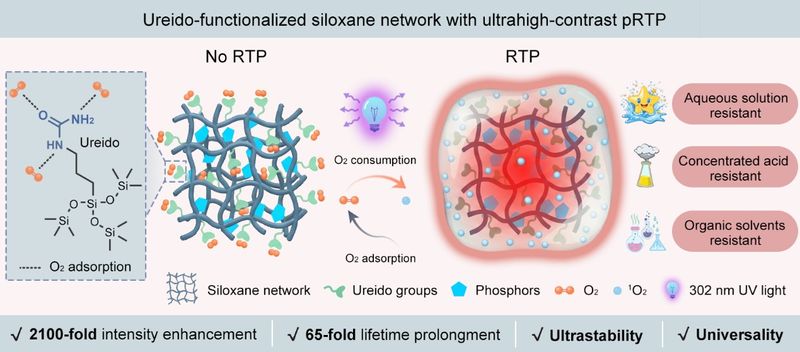
Photoactivated room-temperature phosphorescence (pRTP) materials, with their non-invasive photoresponsiveness, high reversibility and color tunability, have broad application prospects in fields such as information encryption, optical printing and biomedicine.
However, traditional photoactivated polymer hosts, such as polyvinyl alcohol (PVA) and polymethyl methacrylate (PMMA), mainly rely on passive oxygen penetration, leading to low photoactivation efficiency, limited contrast, and poor stability of polymer matrices in harsh environments such as aqueous solutions, organic reagents or concentrated acids, which seriously restricts their scope of application.
To address the above challenges, the research team innovatively designed a ureido-functionalized siloxane network derived from the hydrolysis and crosslinking of γ-ureidopropyltriethoxysilane (UPTES) as a new photoactivation host matrix. By doping with various phosphorescent guest molecules, a series of high-performance pRTP host-guest systems have been successfully constructed.
Studies have shown that the ureido groups in the UPTES network possess a strongly active oxygen-trapping capability, with an adsorption energy much higher than that of common host matrices such as boric acid (BA), PVA and PMMA. They can actively enrich oxygen to achieve complete quenching of guest phosphorescence, establishing a true initial “off” state. Under 302 nm UV irradiation, the system converts the captured triplet oxygen (³O₂) into singlet oxygen (¹O₂), consuming oxygen and thus suppressing the oxygen-mediated quenching of triplet excitons.
This results in an enhancement of phosphorescence intensity by up to approximately 2100-fold and an extension of lifetime by approximately 65-fold, thereby achieving ultrahigh contrast.
The UPTES host matrix exhibits excellent universality and can be combined with various phosphorescent guest molecules with different structures to realize efficient pRTP, with emission colors spanning the visible spectrum. More importantly, owing to the dense and robust siloxane network, the UPTES systems maintain efficient pRTP performance even after repeated photoactivation cycles or being placed in aqueous solutions, organic reagents or concentrated acid for more than 90 days, significantly outperforming traditional polymer host matrices.
Based on the above properties, the team further developed multi-level information encryption patterns and dynamic QR codes, enabling on-demand customization of pRTP systems for advanced multi-level information encryption.
Yating Gao, a postdoctoral fellow, and Ying Zhang, a graduate student, from the School of Chemistry and Molecular Engineering are the co-first authors of the paper. Professor Xiang Ma, Professor Dawei Li and Distinguished Associate Researcher Binbin Chen are the co-corresponding authors. This work was financially supported by the National Natural Science Foundation of China, the Frontiers Science Center for Materiobiology and Dynamic Chemistry (Ministry of Education), the Science and Technology Commission of Shanghai Municipality, and the Feringa Nobel Prize Scientist Joint Research Center.