 08 May 2026
Recently, a research team led by Professor Yongdi Liu from the School of Resources and Environmental Engineering at ECUST achieved progress in the field of persulfate-based advanced oxidation processes. The findings were published in Angewandte Chemie International Edition under the title “Process-Driven Protonation in Benzothiadiazole-Integrated Covalent Organic Frameworks: Activation of Peroxymonosulfate for Pollutant Oligomerization via Dominant Electron Transfer Process”.
Traditional peroxymonosulfate (PMS) activation typically follows a static, catalyst-centered paradigm, constrained by radical-mediated pathways with limited selectivity and incomplete mineralization. Going beyond this convention, the study established a process-driven protonation strategy that steers PMS activation toward a dominant electron transfer process (ETP), enabling selective pollutant oligomerization.
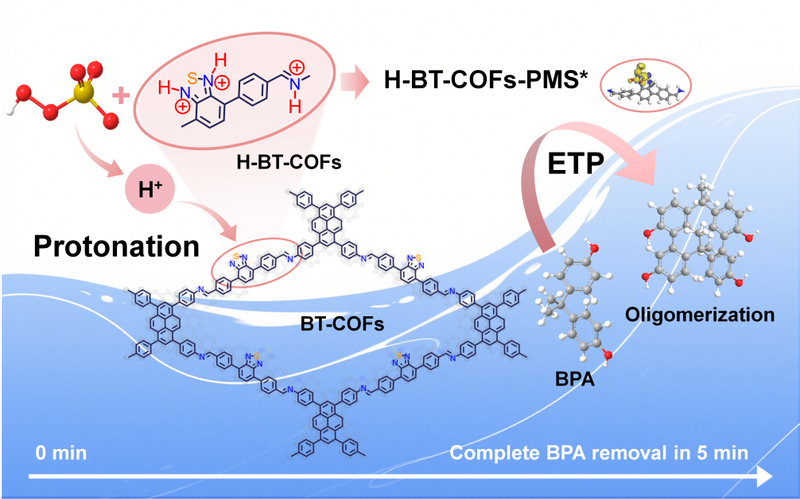
By developing benzothiadiazole-integrated covalent organic frameworks (BT-COFs) as a model platform, it was demonstrated that PMS addition intrinsically acidifies the reaction medium, triggering in situ framework protonation at specific nitrogen sites. This self-induced protonation effect functions as a molecular switch, reorganizing the interfacial electronic structure and generating a polarized catalytic interface that facilitates directional electron transfer rather than radical generation.
As a result, the ETP-directed oligomerization pathway enabled complete removal of bisphenol A (BPA) within 5 minutes (kobs = 1.68 min−1). Moreover, the dynamic catalytic interface could be regenerated through a simple process and exhibited outstanding stability in complex water matrices. The study redefines PMS as an active interfacial regulator and proposes a dynamic, process-adaptive conceptual framework for designing intelligent metal-free systems for sustainable environmental remediation.
ECUST is the sole corresponding institution of the paper. PhD candidate Caixin Xiang is the first author, while Professor Yongdi Liu and Professor Juying Lei serve as corresponding authors. The research was conducted under the guidance of Professor Jinlong Zhang and Associate Professor Liang Zhou. It was supported by the National Natural Science Foundation of China and other funding programs.