 11 May 2026
Recently, Professor Menghao Cai’s team from the School of Biotechnology at ECUST published an article titled “The industrial yeast Komagataella phaffii blooms for advanced biomanufacturing” in the biotechnology review journal Biotechnology Advances (IF 12.5). This article systematically summarizes the recent progress and key technological advancements of this strain in advanced biomanufacturing.
The review highlights that K. phaffii has expanded beyond its traditional role as a conventional expression host, and has emerged as a versatile industrial chassis that supports bulk recombinant protein production, natural product biosynthesis, utilization of sustainable C1 and C2 substrates, and programmable genetic regulation.
Focusing on its performance enhancement and functional expansion, the authors systematically discuss chassis evolution, product spectrum expansion, C1 and C2 substrate utilization, and genetic toolbox development, presenting a clear evolutionary trajectory from a “protein expression system” to a “versatile cell factory.”
This strain initially established a classic protein expression platform relying on methanol metabolism and the methanol-inducible strong AOX1 promoter system. With the advancement of genomics, systems biology, and genome-editing technologies, its chassis attributes have been further activated.
As a host combining high cell-density fermentation capabilities and eukaryotic protein processing advantages, this yeast has progressively developed systematic advantages in secretory expression efficiency, protein quality control, and downstream purification compatibility, laying the foundation for its transition from an expression system to a versatile industrial chassis.
Building upon this foundation, the strain has continuously expanded its utility in recombinant protein production, with applications spanning biopharmaceuticals, industrial enzymes, food proteins, feed proteins, and biomaterials. Through the continuous optimization of expression regulation and secretion pathways, it has demonstrated robust stability and scalability in the efficient expression of diverse proteins, gradually evolving from a platform for high-value-added proteins to a dominant host for bulk recombinant protein production.
Driven by advancements in metabolic engineering and multienzyme synergistic strategies, this strain has made rapid progress in the biosynthesis of complex natural products. It has demonstrated promising capacity for the biosynthesis of diverse natural products, including flavonoids, alkaloids, terpenoids and polyketides. This reflects its ability to stably accommodate complex metabolic pathways and multienzyme systems, marking a functional extension from “protein synthesis” to “complex molecule biosynthesis.”
Distinct from traditional fermentation systems that rely on sugar-based substrates, this strain possesses unique advantages in utilizing non-food carbon sources. Centered on metabolic rewiring for C1 and C2 substrates such as methanol, formate, ethanol, and acetate, this yeast is progressively establishing a substrate utilization system tailored for low-carbon biomanufacturing. This provides a novel technological pathway to alleviate food resource competition and reduce carbon emissions.
Concurrently, the refinement of genetic toolboxes is accelerating the engineering process of this strain. The development of technologies such as CRISPR/Cas9 genome editing, multiplex integration, and synthetic promoter and transcriptional regulation engineering has equipped it with precise regulatory and modular design capabilities. Integrated with multi-omics analysis and computational design methods, this chassis is rapidly evolving into a predictable and programmable cell factory system.
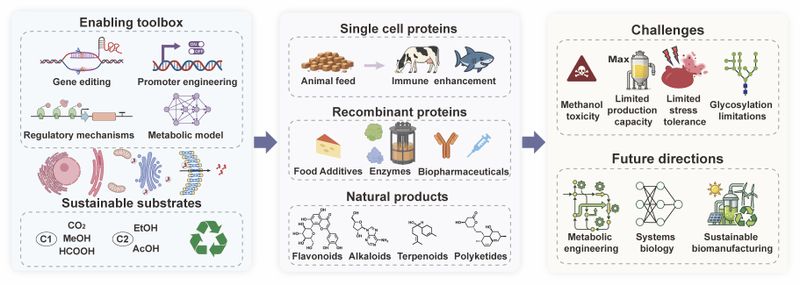
Figure Caption: Engineering strategies and application systems of K. phaffii for advanced biomanufacturing.
Despite its broad application potential, K. phaffii still faces challenges in achieving ultra-high-level protein expression, improving the synthesis efficiency of complex products, and maintaining stability during industrial scale-up. Future efforts leveraging integrated multi-omics analysis, dynamic regulation, metabolic engineering, process intensification, and genome-scale metabolic modeling are expected to further enhance its engineering robustness and industrial compatibility, establishing it as a next-generation core chassis host for advanced biomanufacturing.
This review article was conducted by Professor Menghao Cai’s research group at the State Key Laboratory of Bioreactor Engineering, ECUST. PhD candidates Wen Lv, Yunhao Li, and Shijie Wang are the co-first authors, with Professor Menghao Cai serving as the corresponding author. This work was supported by the Shanghai Explorer Program and the Shanghai Agricultural Science and Technology Innovation Project.