 13 May 2026
Recently, the research team led by Academician Weihong Zhu and Professor Weiwei Zhang from the Feringa Nobel Prize Scientist Joint Research Center, School of Chemistry and Molecular Engineering, ECUST, has achieved a major breakthrough in the field of photochemical green synthesis of hydrogen peroxide using nanoscale covalent organic frameworks (COFs). The findings, entitled “Synergizing Mass Transfer and Exciton Dissociation in Nanoscale COFs for Efficient H₂O₂ Photosynthesis,” have been published in Angewandte Chemie International Edition (Angew. Chem. Int. Ed. 2026, e6474422, https://doi.org/10.1002/anie.6474422).
Efficient proton-coupled electron transfer is key to photocatalytic H₂O₂ production. Nevertheless, traditional photocatalytic materials suffer from three bottlenecks: limited light-harvesting capacity, low charge separation efficiency and inefficient reactant mass transfer. Simultaneously addressing these three challenges within a single system has long been a core scientific puzzle in this field.
To address this challenge, the team leveraged the unique advantages of COFs, including their structurally designable frameworks and tunable sizes, and proposed a synergistic strategy combining nanoscale morphological control with pore-wall functionalization.
Specifically, nanoscale morphological control is designed to enhance light harvesting and exciton dissociation efficiency, while carboxylic acid-modified pore walls optimize the confined water microenvironment and proton delivery behavior. By integrating bottom-up construction of nanoscale COFs with click chemistry-based modification, the team precisely introduced carboxylic acid groups into the framework.
While maintaining high crystallinity, they achieved synergistic regulation of COF particle size and pore-wall chemical microenvironment, and fabricated highly functionalized nanoscale COF photocatalysts.
Experimental results show that compared with traditional micrometer-sized bulk counterparts, nanoscale COFs possess better dispersibility and shorter exciton diffusion paths, which significantly boost light-harvesting capacity and photoinduced charge-separation efficiency, and effectively suppress exciton recombination.
Carboxylated pore walls induce confined water molecules to form ordered hydrogen-bond chains, accelerating proton delivery, lowering the kinetic barrier for proton-coupled electron transfer, and achieving synergistic enhancement of electron and proton transfer. Benefiting from the synergistic optimization of crystallinity, hydrophilicity and proton transfer capacity, thiopropanoic acid-modified TPB-PD-COOH exhibits outstanding H₂O₂ photosynthesis performance in pure water under ambient air.
Under AM 1.5G simulated solar irradiation, its H₂O₂ evolution rate reaches 11246 μmol g⁻¹ h⁻¹, over seven times that of pristine bulk COFs, with a solar-to-chemical conversion efficiency of 2.18%, outperforming most reported COF-based photocatalysts.
Furthermore, taking advantage of the excellent solution dispersity of nanoscale COFs, the team compounded them with sodium alginate and prepared hydrogel microspheres via ionic cross-linking, which were successfully applied in flow-through reaction devices. The system operates stably under continuous outdoor natural sunlight irradiation, demonstrating great prospects for practical applications.
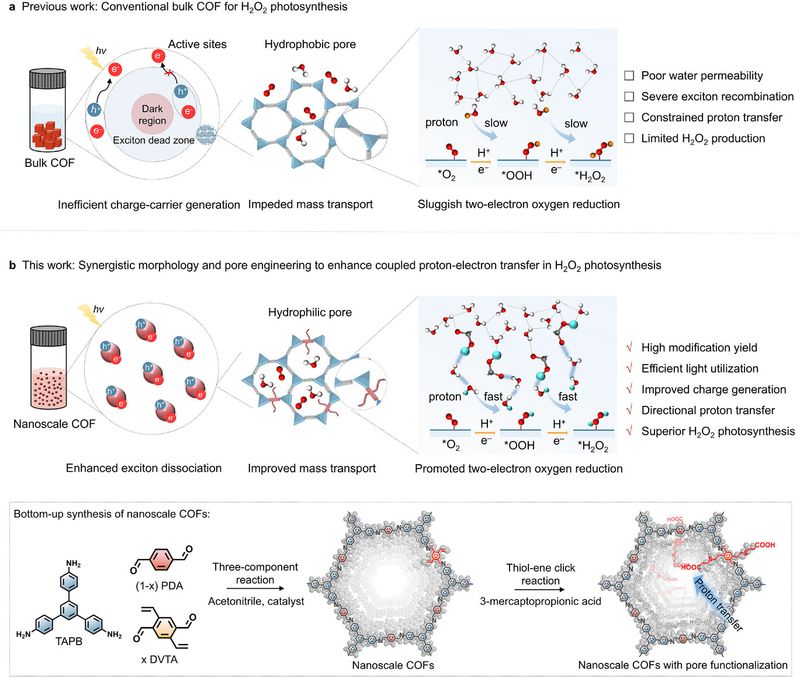
Figure 1: Schematic comparison of bulk and nanoscale COFs for photocatalytic H₂O₂ production.
In summary, by innovatively combining morphological control with pore-wall functionalization, this study fabricates nanoscale COF photocatalysts with high crystallinity, dispersity and functionality.
It establishes a novel material-design paradigm for simultaneously optimizing exciton dynamics and proton delivery, and realizes synergistic reinforcement of electron and proton transfer processes, serving as a typical example of the “new three-transfer” concept in chemical engineering. This work not only provides a new pathway for green H₂O₂ production, but also offers crucial references for the development of solar-driven green chemical processes.
This research was mainly completed by Xinman Liu (postdoctoral researcher) and Xiyin Zhan (master’s student) from the School of Chemistry and Molecular Engineering, ECUST. The corresponding authors are Professor Weiwei Zhang and Dr. Guanhua Ren.
The work received guidance from Academician Weihong Zhu and Academician He Tian. It was supported by the National Natural Science Foundation of China, Department of Science and Technology of the Ministry of Education, Science and Technology Commission of Shanghai Municipality, Feringa Nobel Prize Scientist Joint Research Center and other funding agencies.