 14 May 2026
Recently, the team led by Professor Xiang Ma and Associate Professor Bingbing Ding from the Feringa Nobel Prize Scientist Joint Research Center of the School of Chemistry and Molecular Engineering, ECUST, has achieved important progress in flexible ultralong room-temperature phosphorescence materials. The findings, titled “Harmonizing High Phosphorescence Efficiency and Stretchability in Flexible Afterglow Materials through Microphase Engineering,” was published in Advanced Materials (2026, e73314).
Organic ultralong room-temperature phosphorescence (OURTP) materials show broad application prospects in flexible optoelectronics, but they have long faced a trade-off between phosphorescence efficiency and mechanical flexibility. High phosphorescence efficiency requires a rigid microenvironment to stabilize triplet excitons and suppress non-radiative decay, whereas excellent stretchability and resilience depend on sufficient molecular-chain mobility. This intrinsic conflict has severely restricted the development of flexible afterglow materials.
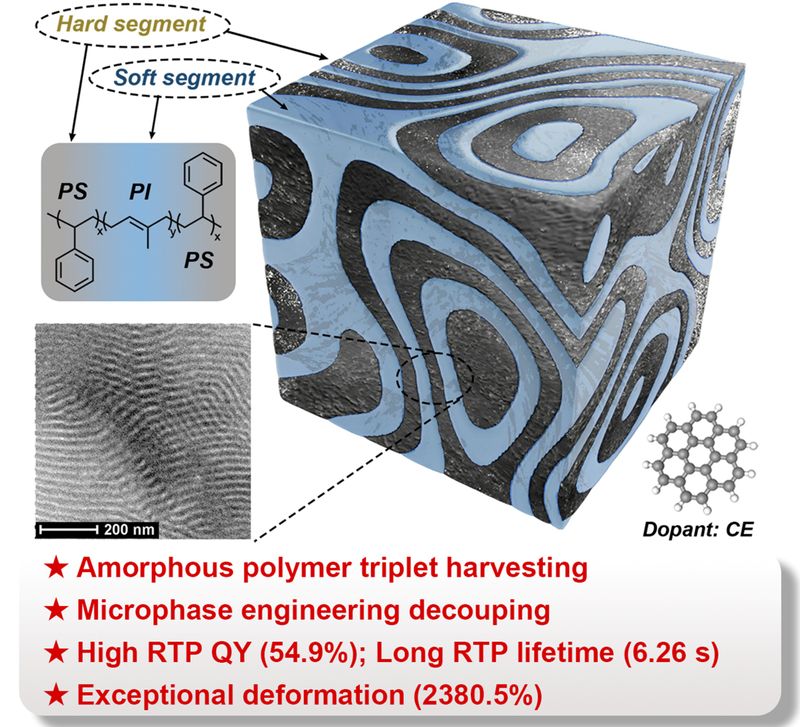
To address this challenge, the research team proposed a new microphase engineering strategy based on the intrinsic microphase-separated structure of block copolymers. In this system, the rigid phase effectively immobilizes the phosphors and facilitates charge-transfer-mediated room-temperature phosphorescence, endowing the material with a high phosphorescence quantum yield (Φ=54.9%) and an ultralong lifetime (τ=6.26s). Meanwhile, the flexible phase provides excellent entropy elasticity through reversible segmental motion, enabling the material to achieve ultra-stretchability with an elongation at break of up to 2380.5% as well as outstanding fatigue resistance, remaining intact after 40 cycles under 600% strain.
The team further demonstrated the material’s application potential in smart wearables, stress sensing, sunlight-activated self-uminescent warning systems, and photodynamic antibacterial applications, providing a general design strategy for the development of next-generation multifunctional flexible optoelectronic devices.
The corresponding authors of the article are Professor Xiang Ma and Associate Professor Bingbing Ding, and the first author is Ping Jiang, a postdoctoral researcher from the School of Chemistry and Molecular Engineering. The research was conducted under the guidance Academician He Tian and was supported by the National Natural Science Foundation of China and the Science and Technology Commission of Shanghai Municipality.