 12 May 2026
Advanced oxidation technologies based on environmental functional materials are regarded as key technologies for deep industrial pollution treatment and coordinated carbon reduction.
Nevertheless, a huge gap remains between laboratory research and practical engineering applications. Many materials systems that exhibit excellent performance at the milligram scale in laboratories are unable to meet the demands of ton-scale operation, continuous processing, and complex real-world conditions.
Traditional research paradigms have focused excessively on maximizing intrinsic material performance and elucidating catalytic mechanisms, while largely overlooking key constraints associated with large-scale deployment, including engineering feasibility, economic sustainability, operational stability, low-carbon requirements, and safety considerations.
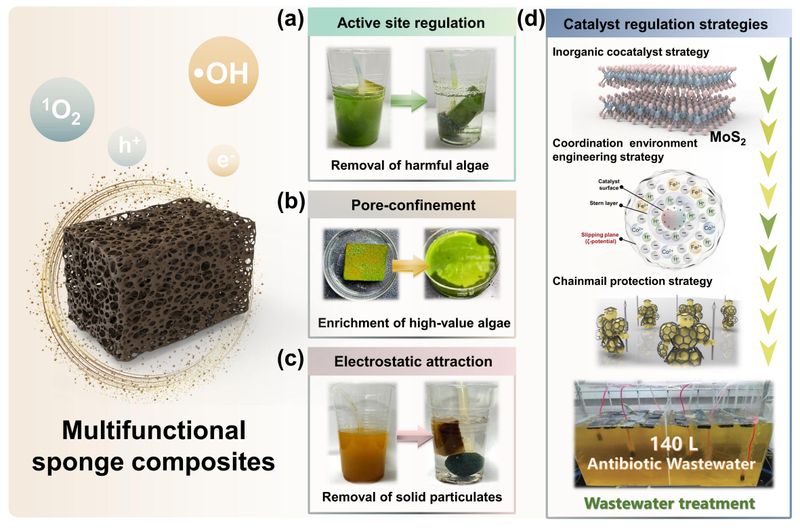
To address this issue, the research team led by Mingyang Xing, Professor from the School of Chemistry and Molecular Engineering, developed low-cost multifunctional sponge composite materials.
The team integrated laboratory-scale material design and mechanism exploration with practical applications, and proposed a low-carbon and low-toxicity design strategy that shifts the research paradigm from a “material-centered” approach to one oriented toward real operational demands.
The research was published in Accounts of Materials Research under the title “Application-Oriented Advanced Oxidation Processes: Key Challenges and Pathways toward Large-Scale Deployment”.
The study established a closed-loop research framework centered on engineering feasibility, economic sustainability and environmental safety. It adopted real engineering demands to guide targeted material design, scales up material performance via equipment development and matching optimization, and introduced Life Cycle Assessment (LCA) and Techno-Economic Analysis (TEA) to control energy consumption, carbon emissions, costs and environmental risks at the source.
By formulating industrial standards and conducting engineering demonstration projects, the framework helped shorten the transition from laboratory research to practical application, offering a reliable route for the industrialization of environmental functional materials under the dual-carbon goal.
ECUST is the sole corresponding institution of this achievement. Yue Jiang, Distinguished Associate Researcher from the School of Chemistry and Molecular Engineering, is the first author, and Professor Mingyang Xing is the corresponding author of the paper.
The research was guided by Professor Jinlong Zhang, Member of the Academia Europaea, and supported by the Feringa Nobel Prize Scientist Joint Research Center, the Frontier Science Center for Material Biology and Dynamic Chemistry (Ministry of Education), the National Science Fund for Distinguished Young Scholars, and the National Science Fund for Creative Research Groups (Category B), etc.