 18 May 2026
Recently, the journal Engineering published online a research article titled “Fabricating Efficient White-Light-Emitting Ultra-Small Gold Nanoparticles via a Supramolecular Strategy,” reporting the latest achievement by the team of Professor Xiang Ma and Liangwei Ma, Distinguished Associate Research Fellow from the School of Chemistry and Molecular Engineering, ECUST, in the field of white-light emission from ultra-small gold nanoclusters (AuNCs).
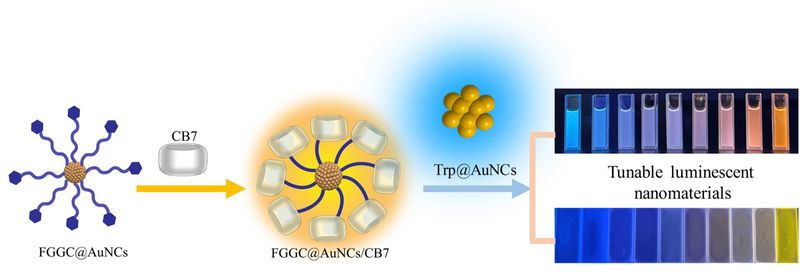
The research team proposed a synergistic emission strategy based on supramolecular host-guest assembly. Using FGGC peptides as ligands, the researchers synthesized ultra-small AuNCs with orange phosphorescence emission (FGGC@AuNCs) via a one-pot method.
By leveraging the host-guest interaction between cucurbit[7]uril (CB7) and the ligands, the vibration and rotation of the ligands were effectively restricted, thereby suppressing their non-radiative decay. As a result, the photoluminescence quantum yield (QY) of the AuNCs increased from 3.5% to 25.4%, while the phosphorescence lifetime was prolonged from 5.6 μs to 9.6 μs.
Building on this work, the team further introduced Trp@AuNCs with strong blue fluorescence emission and integrated them with the FGGC@AuNCs/CB7 assembly. Through the synergistic coupling of fluorescence and phosphorescence, efficient white-light emission was fabricated.
The assembled system exhibited a white-light QY of 22.6%, with International Commission on Illumination (CIE) chromaticity coordinates close to the standard white-light region (0.33, 0.33).
The study also revealed that the luminescence color of the system was highly responsive to temperature and excitation wavelength. Furthermore, the researchers embedded the assembly into polyvinyl alcohol (PVA) matrices to fabricate flexible luminescent films with tunable multicolor emission and successfully constructed white-light LED devices, demonstrating promising potential for applications in flexible displays, temperature sensing, and intelligent optoelectronic devices.
This work presented a new strategy for regulating the luminescence performance of AuNCs through supramolecular non-covalent interactions, providing new insights into the design and fabrication of high-performance white-light nanoluminescent materials and broadening the application prospects of AuNCs in intelligent sensing, information display, and optoelectronic devices.
Professor Xiang Ma and Liangwei Ma, Distinguished Associate Research Fellow, serve as co-corresponding authors of the paper, while Dr. Guojuan Qu is the first author. The research was supported by the National Science Fund for Distinguished Young Scholars and other funding sources.