 26 May 2026
Recently, a research team led by Professor Weijun Zhao and Academician Weihong Zhu from the School of Chemistry and Molecular Engineering, ECUST, made new progress in red organic plastic scintillator materials. The findings were published in Angewandte Chemie International Edition under the title “Hybridized Local and Charge-Transfer Emitter with a Dual-Hindered Indoline Donor for Fast and Efficient Red Plastic Scintillators.”
Scintillators are special materials capable of converting high-energy radiation into visible light and are widely used in high-energy physics, non-destructive testing, biomedical imaging, and other fields.
The research team designed an ultrafast and highly efficient red organic scintillator based on a hybridized local and charge-transfer (HLCT) emitter featuring a strongly dual-hindered indoline donor. Building on their previously developed chair-shaped indoline donor (Angew. Chem. Int. Ed. 2025, e202522144), they constructed donor–acceptor (D–A) type organic molecules, effectively red-shifting the radioluminescence to match the optimal response range of silicon photomultipliers (SiPMs) while providing a large Stokes shift and aggregation-induced emission (AIE) characteristics.
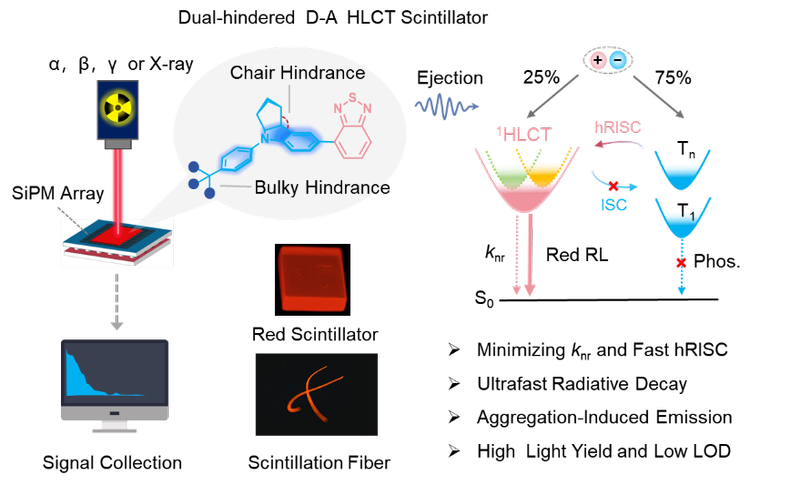
By introducing an additional bulky tert-butyl group, the material attained efficient exciton utilization and an ultrafast decay lifetime of 3.94 ns, making it the fastest reported organic red scintillator to date. Furthermore, the scintillator exhibited a light yield of 24,231 photons MeV−1, 1.8 times that of the commercial benchmark BC-430, a detection limit as low as 168 nGys−1, and an X-ray imaging resolution of 16.8 lp mm−1. Encapsulated plastic scintillators and scintillating fibers demonstrated potential for radiation detection and X-ray imaging, providing a feasible strategy for next-generation organic red and near-infrared scintillators.
The paper’s first author is Qiqi Xu, a PhD candidate from the School of Chemistry and Molecular Engineering, and the corresponding author is Professor Weijun Zhao. The research was conducted under the guidance of Academician Weihong Zhu and Academician He Tian, with additional support from Professor Yaxing Wang of Soochow University. The study was funded by the Basic Science Center Program of the National Natural Science Foundation of China, the National Natural Science Foundation of China, the Innovation Program of Shanghai Municipal Commission of Education, the Shanghai Municipal Commission of Science and Technology, and the China Postdoctoral Science Foundation.