 25 May 2026
Recently, the Catalytic Reaction Engineering team from ECUST made new progress in alkyne semihydrogenation catalysts. The findings were published in Angewandte Chemie International Edition under the title “Substrate-Dependent Selectivity in Alkyne Semihydrogenation over a Hydrogen-Competent Pd₃Sn₂ Intermetallic Catalyst”.
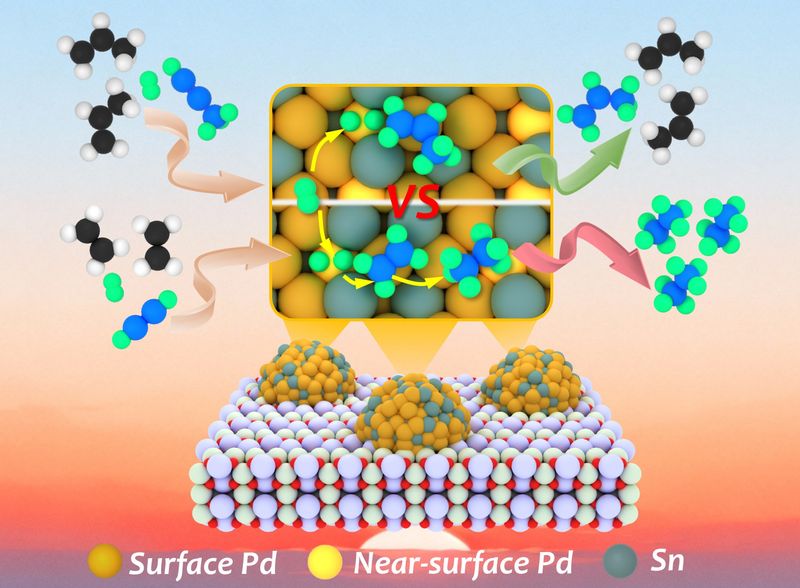
Selective semi hydrogenation of light alkynes is a key reaction in the production of polymer-grade ethylene and propylene via the cracking of naphtha and light alkanes. Although conventional Pd-based catalysts exhibit high activity owing to their unfilled d-orbital electronic structure, they remain prone to over-hydrogenation and coupling side reactions at high alkyne conversions.
Previous studies have demonstrated that precise tuning of the electronic structure and spatial configuration of active sites enables strong σ-adsorption of alkynes and weak π-adsorption of alkenes, thereby breaking the inherent trade-off between activity and selectivity (J. Am. Chem. Soc. 2025, 147, 33, 30178; J. Am. Chem. Soc. 2024, 146, 4993; Angew. Chem. 2024, 63, e202410979; Nat. Commun. 2022, 13, 5534). While rational design of surface-active sites can achieve adsorption configuration matching for hydrocarbon molecules, competitive adsorption between alkynes and H₂ often limits hydrogen activation.
To address this challenge, the research team proposed a design strategy based on the synergy between surface and near-surface active sites. By coupling surface Sn-bridged Pd–Pd dual sites with near-surface Pd sites on a Pd₃Sn₂ intermetallic compound catalyst, they achieved site decoupling between propyne adsorption and hydrogen activation.
Meanwhile, methyl-induced steric repulsion promoted timely propylene desorption, enhancing propyne semi hydrogenation performance. The study also revealed the fundamental origin of selectivity reversal between propyne and acetylene on the same catalytic surface, which arises from substituent effects.
The co-first authors of this paper are Ph.D. candidates Yijing Liang, Ningchao Zhu, and Yundao Jing. The corresponding authors are Professor Xuezhi Duan, Distinguished Research Fellow Yueqiang Cao, and Distinguished Research Fellow Xiaohu Ge, all from the Catalytic Reaction Engineering team, School of Chemical Engineering, ECUST.
The work was conducted under the guidance of Academicians Weikang Yuan and De Chen, as well as Professor Xinggui Zhou. This research was supported by the National Key R&D Program of China, the National Natural Science Foundation of China, and programs from the Shanghai Municipal Commission of Education and the Shanghai Municipal Commission of Science and Technology.