 10 Aug 2026
Recently, a research team led by Professor Xiang Ma from the Feringa Nobel Prize Scientist Joint Research Center, School of Chemistry and Molecular Engineering, has proposed an innovative design strategy of host dearomatization for organic room temperature phosphorescent materials, achieving a substantial improvement in the lifetime of organic room temperature phosphorescence.
The related findings, titled “Host Dearomatization for Prolonging Room-Temperature Phosphorescence”, were published in Angewandte Chemie (Angew. Chem. Int. Ed., 2026, e6451405).
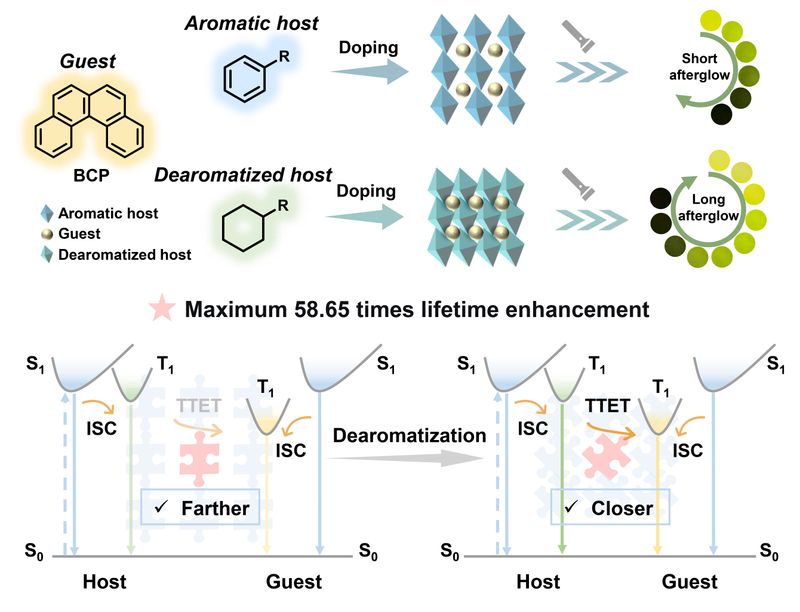
Organic room‑temperature phosphorescent materials, characterized by large Stokes shifts, long lifetimes and rich excited‑state behaviours, show broad prospects in information encryption, bioimaging and optoelectronic displays. However, triplet excitons readily undergo non‑radiative decay, making long‑lived, efficient room‑temperature phosphorescence a persistent challenge. The host‑guest doping strategy, which disperses guests in rigid matrices to suppress molecular motion and oxygen quenching, is a conventional route to high‑performance materials.
Building on prior work, the team proposed a host dearomatization strategy, converting planar aromatic rings in host molecules into three‑dimensional cyclohexane structures to reconstruct the host skeleton. This modulation shortened host‑guest distances, strengthened intermolecular interactions and triplet‑triplet energy transfer (TTET), stabilized triplet excitons, and markedly prolonged phosphorescence lifetime.
Extended to multiple host‑guest systems, the strategy yielded consistent lifetime enhancement of up to 58.65‑fold, confirming its universality. Crystal‑structure analysis, thermal analysis, transient‑absorption spectroscopy and theoretical calculations showed that dearomatization reshaped host packing and excited‑state evolution, enriching and stabilizing triplet states via enhanced TTET. Leveraging the prolonged lifetime, the team built time‑resolved encryption systems based on the Vigenère cipher and Morse code, and developed reversible smart adhesives, demonstrating the potential applications in information security and smart materials.
The corresponding authors are Professor Xiang Ma, Dr. Xiujun Liu and Dr. Zhenyi He. The first author is master’s student Jialin Qin. This work was supported by the NSFC Basic Science Center Project and the National Science Fund for Distinguished Young Scholars.