 15 Aug 2026
Near-infrared (NIR) phosphorescent materials are regarded as ideal candidates for next-generation in vivo imaging and diagnostic technologies due to their excellent tissue penetration, long lifetime, and high signal-to-noise ratio. However, constrained by the energy gap law, the inherently low triplet energy levels of NIR phosphorescent materials significantly increase the rate of non-radiative transitions, resulting in generally low phosphorescence quantum yields. This inherent drawback severely limits their performance in detection sensitivity, drug loading efficiency, and photodynamic therapy efficacy. Moreover, most current high-performance NIR phosphorescent materials rely on complex covalent ring structures and organometallic complexes, which are not only synthetically challenging but also potentially biotoxic, greatly hindering their practical applications. Therefore, the development of novel NIR phosphorescence systems with simple structures and high efficiency has become an urgent need in this field.
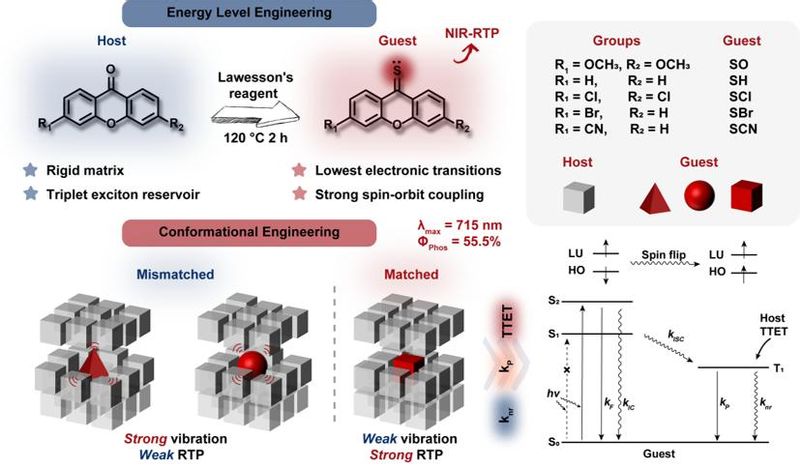
Recently, the research team led by Academician He Tian and Professor Xiang Ma from the School of Chemistry and Molecular Engineering at East China University of Science and Technology developed a “conformational matching” strategy based on aromatic thioketone units, enabling the rational construction of efficient host-guest NIR phosphorescent materials. The findings, titled “Harnessing Host-Guest Conformational Matching for Efficient Near-Infrared Phosphorescence”, have been published in the Journal of the American Chemical Society (J. Am. Chem. Soc., 2026, DOI: 10.1021/jacs.6c12747).
The high efficiency originates from the conformational matching between the guest and host molecules. By optimizing molecular stacking and conformation, exciton localization can be achieved. The resulting materials exhibit the longest emission peak at 715 nm, with a maximum phosphorescence quantum yield as high as 55.5%. Mechanistic studies further reveal that “conformational matching” can simultaneously regulate non-radiative transition rates, radiative transition rates, and triplet-triplet energy transfer processes, thereby achieving synergistic performance enhancement. This work not only provides a new design strategy for efficient NIR phosphorescent materials with simple structures, but also establishes conformational engineering as a new dimension for tuning host-guest phosphorescent properties.
Professor Xiang Ma and Research Associate Professor Zizhao Huang from the School of Chemistry and Molecular Engineering are the corresponding authors of this paper. Dr. Zhiqin Wu is the first author. The research was completed under the guidance of Academician He Tian. This work was supported by the Basic Research Center Program of the National Natural Science Foundation of China (NSFC) and the National Science Fund for Distinguished Young Scholars.