 07 Aug 2026
Recently, Professor Xuezhi Duan and Research Professor Yueqiang Cao from the Catalytic Reaction Engineering team at ECUST have made new progress in the data‑driven design of electrocatalysts for selective hydrogenation.
To address the challenge of enormous chemical space for complex catalytic materials and low screening efficiency via conventional trial‑and‑error approaches, the team established a complete research workflow covering theoretical dataset construction, descriptor‑driven prediction, candidate material screening, catalyst fabrication, performance evaluation and mechanistic validation.
The findings, titled “Data‑Guided Discovery of Cu‑Host Single‑Atom Alloys for Selective Electrohydrogenation via Intermediate Hydrogen Binding”, were published in the Journal of the American Chemical Society.
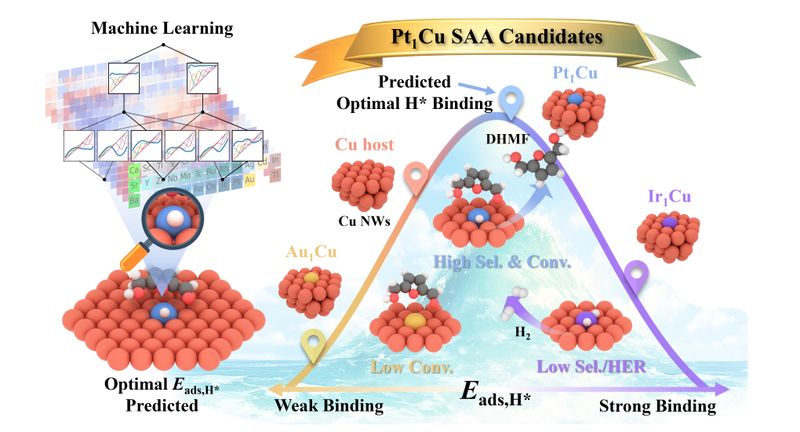
Electrocatalytic selective hydrogenation relies on coupled reaction processes, and its catalytic performance is primarily governed by the surface adsorption strength of hydrogen species (H*) on catalysts. Single-atom alloys can precisely tailor the electronic structure and local coordination environment of active sites at the atomic level, tuning H* adsorption while maintaining the structural stability of host metals. However, the vast combinatorial space of elemental pairs and structural variations makes conventional trial-and-error experimentation inefficient for screening ideal catalysts with optimal H* adsorption.
To address this issue, the team evaluated H* adsorption behaviors of various Cu-based single-atom alloys. By constructing a multi-dimensional material database and developing an interpretable machine learning model, the rapid prediction of H* adsorption strength was achieved for different catalyst candidates.
Experimental validation was conducted via the electrocatalytic selective hydrogenation of 5-hydroxymethylfurfural. The screened Pt₁Cu catalyst exhibited a high target-product Faradaic efficiency of over 90% across a wide potential range and effectively inhibited hydrogen evolution and side reactions. The H*-adsorption-guided design principle was further confirmed in furfural hydrogenation.
Electrochemical kinetics, in-situ spectroscopy, and density functional theory calculations demonstrated that single-atom Pt doping efficiently modulated the H* adsorption of Cu surfaces. Moderate H* adsorption strength balanced active hydrogen generation and hydrogenation, stabilized key reaction intermediates, facilitated target hydrogenation pathways, and suppressed competitive reactions.
This work not only developed a high-performance Pt₁Cu electrocatalyst for selective hydrogenation but also established a complete data-driven catalyst design paradigm integrating descriptor screening, theoretical modeling, machine learning prediction and experimental verification. It provided an efficient strategy for catalyst exploration in complex material systems and held broad application potential for diverse catalytic reactions.
PhD candidate Yundao Jing and Research Professor Xiaohu Ge are the co‑first authors of this paper. The corresponding authors are Professor Xuezhi Duan and Research Professor Yueqiang Cao from the Catalytic Reaction Engineering team.
This research received guidance from Academician Weikang Yuan, Academician De Chen and Professor Xinggui Zhou. The work was financially supported by the National Key Research and Development Program of China, the National Natural Science Foundation of China, the Fundamental Discipline and Interdisciplinary Breakthrough Program of the Ministry of Education, as well as programs from the Shanghai Municipal Education Commission and the Science and Technology Commission of Shanghai Municipality.