 27 Jul 2026
Recently, the research team led by Academician Weihong Zhu and Professor Zhiqian Guo from the School of Chemistry and Molecular Engineering, ECUST, has achieved progress in the research on new paradigms for oxygen-driven chemiluminescence.
The team proposed a new design strategy of oxygen-driven [2+2] photocycloaddition chemiluminescence, and constructed a series of novel Rubines chemiluminescent dyes with high biocompatibility. This innovation realized the ultra-high-sensitivity in vivo visual tracking of the progression of brain diseases. The relevant findings, titled “Oxygen-driven [2+2] photocycloaddition for in vivo chemiluminescence”, were published in Journal of the American Chemical Society.
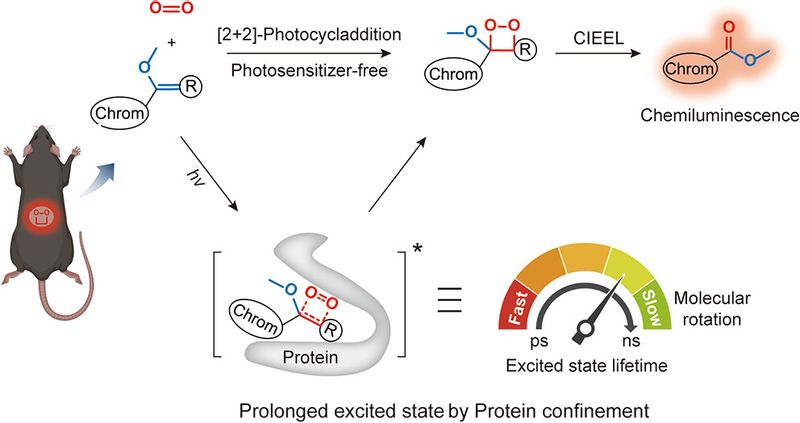
High-energy cyclic peroxides serve as the core energy source for chemiluminescence. Traditional chemiluminescent substrates rely heavily on reactive oxygen species (ROS) to produce luminescent intermediates, making them susceptible to physiological interference and limiting their in vivo detection performance. In contrast, natural bioluminescence systems utilize endogenous molecular oxygen under enzymatic catalysis with superior biocompatibility. Developing enzyme-free, oxygen-driven chemiluminescence via pure chemical strategies has long been a key bottleneck in the field.
To overcome this challenge, the team led by Academician Weihong Zhu and Professor Zhiqian Guo proposed an innovative oxygen-alkene [2+2] photocycloaddition strategy that mimicked natural bioluminescence to directly generate cyclic peroxides. Through rational molecular design, electron-rich substituents activated olefin substrates, while endogenous protein-based confined microenvironments stabilized short-lived excited-state intermediates by suppressing molecular relaxation.
The synergistic effect of electronic activation and confined catalysis enabled efficient [2+2] photocycloaddition under physiological conditions without external photoinitiators. The newly developed Rubines chemiluminescent dyes exhibited excellent in vivo luminescence performance comparable to traditional luciferin bioluminescence systems, featuring simplified reaction conditions and significantly improved biocompatibility.
Applied to high-precision in vivo brain imaging, Rubines dyes achieved unprecedented evaluation of blood-brain barrier (BBB) integrity. Abnormal BBB permeability is an early biomarker of severe brain diseases. Relying on molecular oxygen rather than ROS, the dyes avoided brain background interference and realized ultra-sensitive, real-time, reversible monitoring of BBB damage and repair. This oxygen-driven chemiluminescence paradigm provided a new molecular platform for in vivo physiological sensing and early disease detection.
The study was primarily conducted by Research Associate Professor Yutao Zhang from the School of Chemistry and Molecular Engineering at ECUST. Professor Zhiqian Guo was the corresponding author, and the study was conducted under the guidance of Academician Weihong Zhu. The research also received support from Professor Weimin Liu of ShanghaiTech University and Professor Weijie Chi of Hainan University.
This work was carried out relying on platforms including the Frontiers Science Center for Materiobiology and Dynamic Chemistry (Ministry of Education), the Feringa Nobel Prize Scientist Joint Research Center, and the Photosensitive Products Research Center, and was funded by projects such as the National Key Research and Development Program and the National Science Fund for Distinguished Young Scholars.