 24 Jul 2026
Recently, a research team led by Professor Ben L. Feringa, Professor Da-Hui Qu, and Associate Professor Ruirui Gu from the Feringa Nobel Prize Scientists Joint Research Center, School of Chemistry and Molecular Engineering, ECUST, published a paper titled “A Light-Driven Constitutional Pump” in the Journal of the American Chemical Society (J. Am. Chem. Soc., 2026, DOI: 10.1021/jacs.6c11812), reporting progress in non-equilibrium chemistry.
Non-equilibrium states provide the thermodynamic foundation for living systems to resist entropy production and maintain ordered structures and functions. In dynamic covalent chemistry (DCC), constructing and regulating non-equilibrium states is key to mimicking the spatiotemporal and constitutional characteristics of biomolecular machines and developing life-like smart materials. A non-equilibrium state in DCC refers to a condition where dynamic covalent reaction equilibria shift directionally under external energy input and relax back to equilibrium once energy ceases, exhibiting energy-dissipative behavior.
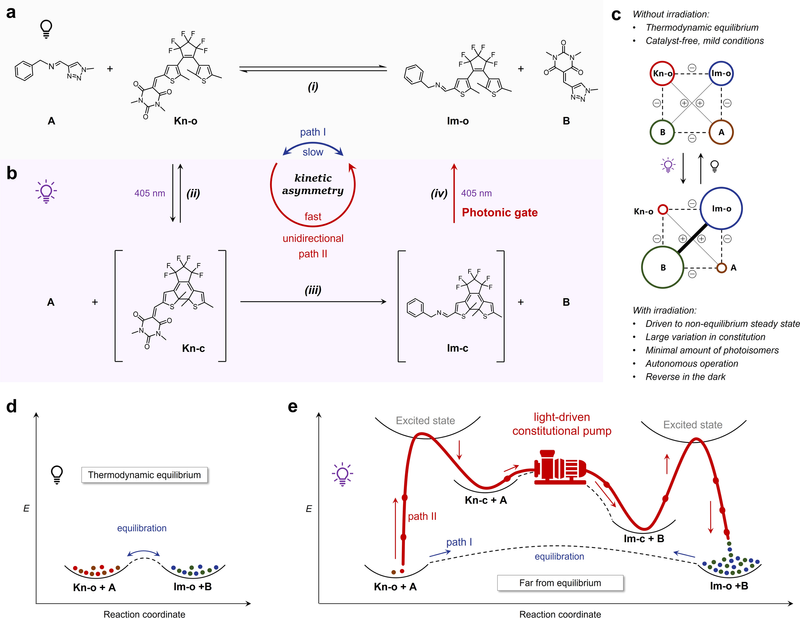
Achieving such states typically requires energy-driven auxiliary reactions to construct reaction networks with kinetic asymmetry. However, maximizing this kinetic difference to realize functional far-from-equilibrium states remains a major challenge. To address this challenge, the team, in collaboration with Professor Jean-Marie Lehn from the University of Strasbourg, proposed a molecular machine concept termed the “light-driven constitutional pump”. By coupling dynamic covalent reactions with photoisomerization, the system establishes a unidirectional cascade pathway that bypasses microscopic reversibility constraints.
The pump relies on a core dual-dynamic molecule, Kn-o, constructed by conjugating a polar olefin moiety with a diarylethene photoswitch. Light irradiation generates a high-energy photoisomer (reaction ii) that drives an irreversible covalent exchange reaction (reaction iii). Meanwhile, the push-pull electronic effect of the polar olefin induces absorption band separation, enforcing a unidirectional ring-opening reaction (reaction iv) via a photonic gating effect. Coupled with the intrinsic dynamic covalent reaction (reaction i), the pump operates as a molecular ratchet driving reaction i far from thermodynamic equilibrium.
Under light irradiation, the steady-state reaction quotient (QNESS = 80.0) increases 28-fold relative to the equilibrium constant (Keq = 2.7). Upon removing light, the system slowly relaxes back to its initial equilibrium and undergoes multiple cycles, demonstrating life-like energy-dissipative characteristics. This strategy offers an approach for regulating non-equilibrium states and developing smart materials.
Ph.D. candidate Chong Li and Dr. Huiping Wu are co-first authors, while Professor Da-Hui Qu, Professor Ben L. Feringa, Professor Jean-Marie Lehn, and Associate Professor Ruirui Gu serve as co-corresponding authors. Academician He Tian provided guidance. Funding was provided by the National Natural Science Foundation of China, the Science and Technology Commission of Shanghai Municipality, and the CNPC Innovation Fund.