 17 Aug 2026
Recently, the research team led by Professor Xiang Ma from the Feringa Nobel Prize Scientists Joint Research Center of the School of Chemistry and Molecular Engineering at ECUST made new progress in extreme temperature-tolerant organic phosphorescent materials. The findings, titled “Phosphorescent Materials with Extreme Temperature Stability via a Dehydration-Shrinkage Strategy”, have been published in the Journal of the American Chemical Society.
Organic phosphorescent materials hold broad application prospects in bioimaging, information storage and encryption, and 3D display due to their large Stokes shift, long lifetime, and rich excited-state behavior. Phosphorescence originates from triplet excitons. As temperature increases, enhanced molecular vibrations accelerate the non-radiative transitions of triplet excitons, leading to rapid phosphorescence attenuation or even quenching. Moreover, luminophores are prone to degradation at high temperatures. How to achieve efficient and persistent organic phosphorescence under extreme high-temperature conditions has remained a major challenge in this field.
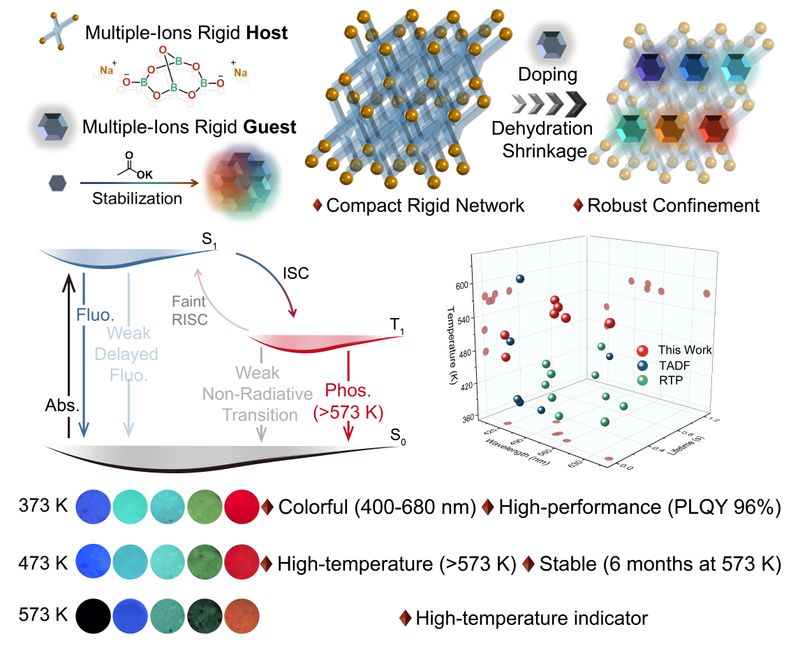
Illustration of doped system construction and high-temperature phosphorescence performance based on the dehydration-shrinkage strategy
To address this challenge, Professor Ma’s team proposed a dehydration-shrinkage strategy. By doping aromatic polycarboxylate potassium salt luminophores into a rigid ionic network of sodium borate (NB), the team successfully constructed a series of doped phosphorescent systems with extreme temperature tolerance. Using different polycarboxylate potassium salt luminophores, the team achieved phosphorescence spanning the full visible spectrum (400-680 nm).
These doped systems maintained full-color phosphorescence emission and long lifetimes even at 573 K. Notably, BP4AK@NB exhibited a lifetime of 296 ms at 573 K, with an afterglow lasting up to 6 seconds. After continuous operation at 573 K for over six months, the material showed virtually no degradation in phosphorescence performance. These results addressed a major limitation of conventional organic phosphorescent materials, whose performance typically declined sharply at elevated temperatures.
Mechanistic studies revealed that this extreme temperature stability originated from the dehydration-shrinkage effect of the sodium borate matrix upon heating. As temperature rose, the coordinated water and structural water in sodium borate were progressively removed, accompanied by shrinkage of the ionic network. This shrinkage process significantly enhanced the rigid confinement of luminophores within the ionic network, effectively suppressed non-radiative transitions of triplet excitons and thereby enabled stable phosphorescence emission at high temperatures. Furthermore, the abundant ionic bonding sites provided by polycarboxylate potassium salt luminophores further strengthened the interaction with the matrix.
Leveraging their excellent multicolor emission and extreme high-temperature tolerance, the team successfully applied these materials in high-temperature safety indication and information encryption, offering new solutions for information observation and secure communication in high-temperature environments.
Professor Xiang Ma is the corresponding author of this paper. Zhenyi He, a postdoctoral fellow from the School of Chemistry and Molecular Engineering, is the first author. This work was supported by the NSFC Basic Science Center Project and the National Science Fund for Distinguished Young Scholars.