 03 Aug 2026
Recently, Professor Sheng Dai from the Feringa Nobel Prize Scientist Joint Research Center and Professor Wangcheng Zhan from the State Key Laboratory of Green Chemical Engineering and Industrial Catalysis at ECUST, in collaboration with Research Professor Beien Zhu from Shanghai Advanced Research Institute, Chinese Academy of Sciences, have made new progress in Pt-based noble metal catalysts for light-alkane oxidation. Their findings were published in Nature Communications under the title “Efficient and durable light-alkane oxidation over sintered Pt catalysts” (Nat. Commun. 2026, 17, 7384).
Supported Pt catalysts are widely used for light-alkane oxidation, but improving Pt dispersion and suppressing nanoparticle sintering have long been considered essential for maintaining catalytic activity, as sintering is conventionally believed to inevitably lead to catalyst deactivation. In this study, the research team challenged this conventional understanding by demonstrating that intentionally pre-sintered Pt particles exhibit superior activity and stability compared with highly dispersed Pt species in complete propane oxidation.
Using MgAl₂O₄ as a thermally stable support, the team constructed sintered Pt catalysts through controlled thermal treatment. Despite a decrease in Pt dispersion from 74% to 6%, the catalyst achieved a substantial improvement in propane oxidation performance, reducing the temperature required for 90% propane conversion from approximately 360°C to 245°C and increasing the Pt mass-normalized reaction rate by nearly 10-fold. The catalyst also maintained excellent stability under water-containing conditions and hydrothermal aging.
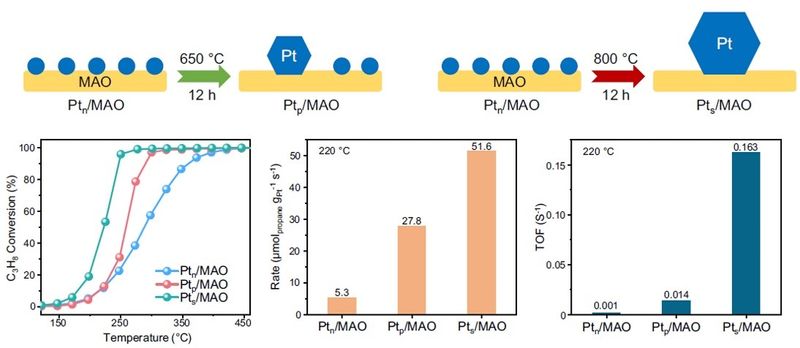
Mechanistic studies revealed that highly dispersed Pt species tend to strongly adsorb oxygen species, leading to surface oxygen poisoning and inhibiting propane activation. In contrast, sintered Pt particles expose stable low-index metallic facets, such as Pt(100) and Pt(111), which maintain suitable oxygen coverage and facilitate C–H bond activation. This work overturns the traditional belief that higher Pt dispersion always leads to better catalytic performance and provides a new strategy for designing highly active and durable noble metal catalysts for oxidation reactions.
ECUST is the first completing institution of this paper. Research Associate Professor Xuan Tang and Dr. Yang You from ECUST, and Dr. Lei Ying from Shanghai Advanced Research Institute, CAS, are co-first authors. Professor Wangcheng Zhan and Professor Sheng Dai from ECUST, and Research Professor Bei’en Zhu from Shanghai Advanced Research Institute, CAS, are co-corresponding authors. The research also received guidance from Professor Yun Guo from ECUST.
This work was supported by the National Key Research and Development Program of China and the National Natural Science Foundation of China, with additional support from research platforms including the State Key Laboratory of Green Chemical Engineering and Industrial Catalysis, the Feringa Nobel Prize Scientist Joint Research Center, and the Frontiers Science Center for Materiobiology and Dynamic Chemistry of the Ministry of Education.