 14 Aug 2026
Recently, Associate Prof. Qi Chen from the School of Materials Science and Engineering at ECUST, in collaboration with partners from Shanghai Ninth People’s Hospital affiliated to Shanghai Jiao Tong University School of Medicine, reported that hyaluronic acid functionalized with a β-amino acid polymer mimicking natural polypeptide-mediated cell adhesion can spontaneously form hydrogels in situ at rabbit corneal defect sites, exhibiting excellent histocompatibility and superior corneal regeneration in vivo.
The research findings were published in Bioactive Materials under the title “Synthetic β-amino acid polymer promoting keratocyte adhesion and corneal regeneration.”
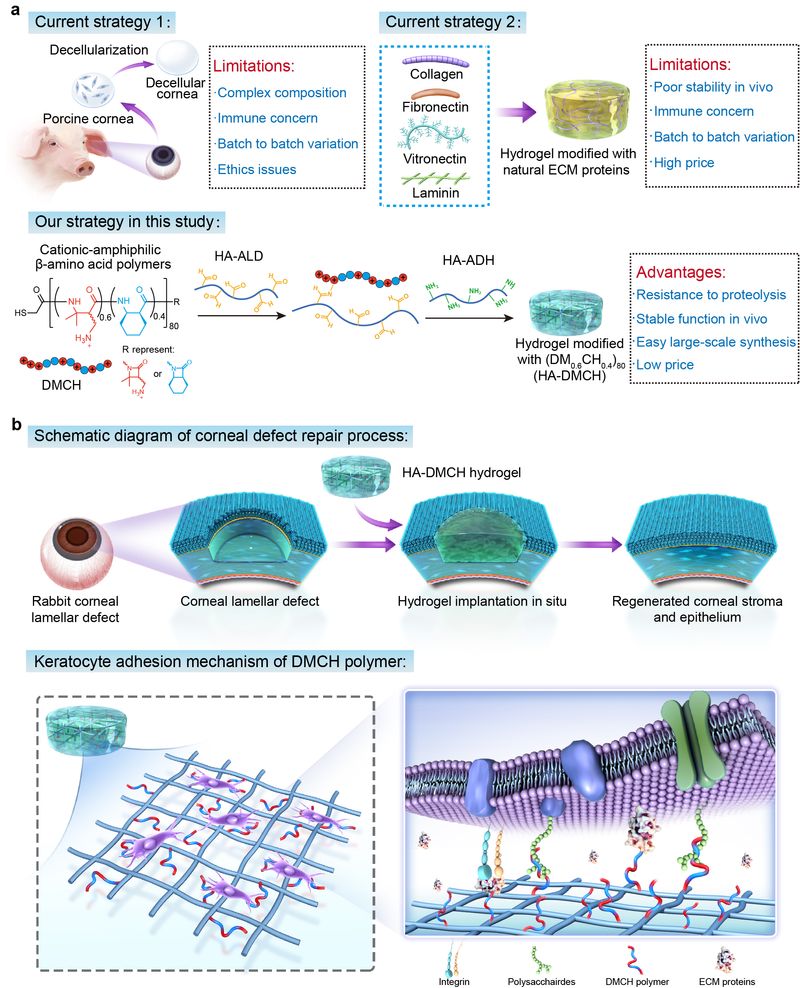
The cornea is critical to vision, and corneal diseases or injuries are the second leading cause of blindness worldwide. Due to donor shortages and high costs, fewer than 5% of patients can receive corneal transplants, creating an urgent need for alternative biomaterials for corneal repair and regeneration.
Current clinical materials, such as decellularized animal corneal stroma and amniotic membrane, face immune rejection, complex composition, and batch-to-batch variation. Biocompatible hydrogels modified with extracellular matrix proteins or peptides are also limited by poor stability and high cost.
To address these challenges, Associate Prof. Qi Chen from ECUST and Director Jin Li from Shanghai Ninth People’s Hospital affiliated to Shanghai Jiao Tong University School of Medicine collaborated to design and synthesize a series of cationic-amphiphilic β-amino acid polymers and explored their ability to promote keratocyte adhesion and corneal regeneration.
It was found that the optimal β-amino acid polymer, (DM₀.₆CH₀.₄)₈₀, effectively promoted the adhesion of human keratocytes. Mechanistic studies indicated that (DM₀.₆CH₀.₄)₈₀ promoted keratocyte adhesion through two pathways: first, ECM proteins adsorbed on the material surface mediated binding to integrins on the cell surface; second, (DM₀.₆CH₀.₄)₈₀ directly bound to cell surface proteins and polysaccharides. Notably, (DM₀.₆CH₀.₄)₈₀ induced human keratocytes to produce ECM proteins and polysaccharides, further promoting cell adhesion and corneal repair.
In addition, synthetic β-amino acid polymers possessed significant advantages, including resistance to proteolysis, stable function in vivo, structural diversity, and ease of large-scale synthesis via one-pot polymerization. These findings demonstrate the potential of β-amino acid polymers as synthetic biomaterials for corneal repair.
This work was jointly completed by ECUST and SJTU. Dr. Mingjiao Chen and Associate Prof. Qi Chen are the co-first authors of the paper, and Prof. Runhui Liu and Director Jin Li are the corresponding authors. This research was supported by the National Natural Science Foundation of China and the Ministry of Science and Technology.