 28 Jul 2026
Recently, the research team led by Professor Jun Hu from the School of Chemistry and Molecular Engineering at East China University of Science and Technology made new progress in high-temperature carbon capture and in-situ conversion technology. The findings, titled “Self-Adaptive Ni Nanoparticles in Perovskite LaNi₁₋ₓAlₓO₃/CaO for Durable CO₂ Capture and In-Situ Conversion”, have been published in the journal Nature Communications.
Integrated Carbon Capture and Conversion (iCCC) technology can fully utilize the waste heat from high-temperature flue gas in the energy and process manufacturing industries to convert captured CO₂ into high-value-added products in situ, thereby avoiding the energy-intensive and costly CO₂ compression and transportation processes, and providing an innovative pathway toward carbon neutrality for key carbon-emitting industrial processes. Developing bifunctional materials that combine high performance and high stability is central to advancing iCCC technology. However, conventional Ni–CaO bifunctional materials are prone to CaO sintering, active metal agglomeration, and carbon deposition deactivation during high-temperature carbon capture and in-situ conversion cycles.
To address these issues, the team proposed a highly efficient anti-sintering strategy using self-adaptive metal catalysts. By precisely controlling the metal–support interaction through B-site Al substitution in the LaNiO₃ perovskite, the team successfully constructed a perovskite–calcium oxide (LaNi₁₋ₓAlₓO₃/CaO) composite bifunctional material. This enables reversible dissolution–exsolution dynamic regulation of nano-sized active metal particles during alternating oxidizing–reducing atmosphere cycles, suppressing Ni particle agglomeration and carbon deposition deactivation under high-temperature redox conditions. Meanwhile, B-site Al substitution in the perovskite optimizes the Ni²⁺/Ni³⁺ valence state ratio, inducing abundant oxygen vacancies and constructing efficient oxygen ion migration channels, which enhances the kinetics of CO₂ adsorption and conversion. In addition, the formation of a perovskite/CaO heterojunction interface effectively separates CaO particles, addressing the bottleneck of CaO sintering during high-temperature carbon capture.
The optimized LaNi₀.₈Al₀.₂O₃/CaO composite bifunctional material exhibits excellent cyclic stability during long-term CO₂ capture and in-situ conversion, with a CO₂ capture capacity as high as 10.2 mol/kg, a captured CO₂ conversion rate of 91.5%, and a CH₄ conversion rate of up to 93.5%, outperforming conventional Ni–CaO catalytic systems. The self-adaptive metal dynamic regulation strategy proposed in this work provides new insights for the structural design of redox multifunctional catalysts.
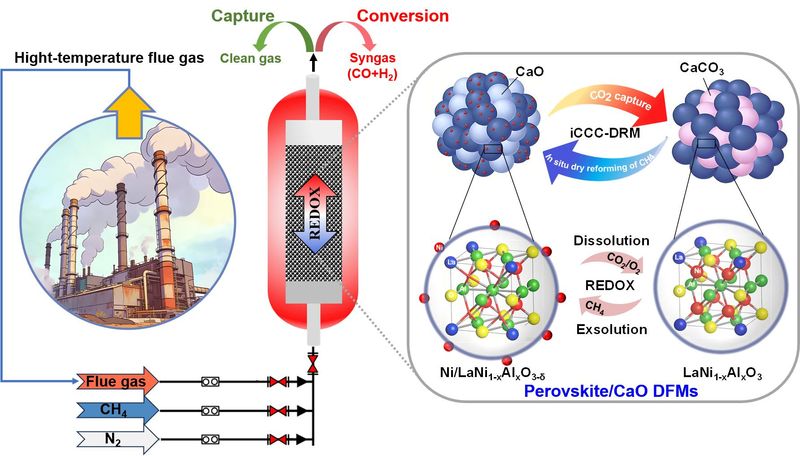
In recent years, Professor Jun Hu’s research group has made a series of advances in CO2 capture and in-situ conversion technologies. The team has developed bifunctional materials for integrated CO2 capture and conversion, elucidated the synergistic mechanisms between adsorption and catalytic intermediates, and improved CO2 capture efficiency and product selectivity through catalyst design and adsorption-catalysis interface regulation. Building on these studies, the team also developed a process integrating flue-gas desulfurization, decarbonization, and in-situ conversion, and identified iCCC-to-methanol as a promising future technological route through process simulation and techno-economic analysis. In collaboration with Sinopec, the team has further developed the world’s first integrated industrial process for high-temperature flue-gas CO2 capture and in-situ conversion to syngas.
ECUST is the sole corresponding institution for this paper. Bin Shao, a Research Associate Professor from the School of Chemistry and Molecular Engineering, is the first author. Professor Jun Hu is the corresponding author. The research was conducted under the guidance of Academician Feng Qian and Professor Honglai Liu. Professor Sheng Dai from the Feringa Nobel Prize Scientists Joint Research Center provided technical support for electron microscopy characterization. The study was supported by the National Key Research and Development Program of China (Ministry of Science and Technology), the Original Exploration Program of the National Natural Science Foundation of China, Ministry of Education Integrated Research Platform for Hydrogen Energy, and the Major Science and Technology Research Projects of China Petrochemical Corporation (Sinopec Group).