 05 Jun 2026
Recently, a research group led by Liangzhu Zhang, Distinguished Associate Research Fellow from the School of Materials Science and Engineering, ECUST, reported a scalable topochemical synthesis strategy for black phosphorene nanoribbons (PNRs). The findings were published in Journal of the American Chemical Society (JACS) under the title “Scalable Topochemical Synthesis of Black Phosphorene Nanoribbons” (DOI: 10.1021/jacs.6c02221).
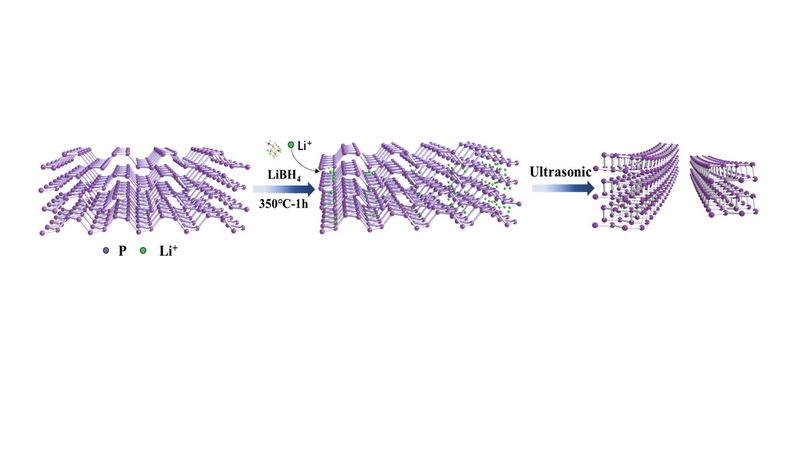
As a unique quasi-one-dimensional nanomaterial, PNRs possess excellent physicochemical properties, such as a tunable bandgap, anisotropic transport properties, and intrinsic magnetism. They show application potential in the fields of flexible electronics, electrocatalysis, and energy storage. Practical applications usually require large quantities of PNR dispersions and powders. Moreover, PNRs can only be exfoliated along the zigzag direction of black phosphorus crystals. Currently, both top-down and bottom-up synthesis strategies struggle to achieve large-scale preparation. This bottleneck has greatly limited the industrial application of PNRs.
The research team utilized a solid-phase lithiation method to achieve lithium-ion intercalation. They prepared liter-scale PNR dispersions and gram-scale PNR powders through lithium-ion scissoring and liquid-phase ultrasonication. Experiments obtained an optimal Li/P intercalation ratio of 0.125, and density functional theory (DFT) further verified the experimental results. The team also compounded PNRs with polymer materials, such as cellulose and gels, to create materials with excellent flame-retardant properties. In addition, the researchers loaded cobalt onto the surface of PNRs. The electrocatalytic oxygen evolution reaction performance indicated that this material possessed high catalytic activity.
The paper’s first author is Zhi Chen, a master’s student from the School of Materials Science and Engineering, ECUST. Liangzhu Zhang, Distinguished Associate Research Fellow from ECUST, Jieming Wang, Associate Professor from Sichuan University, Zhong-Shuai Wu, Research Fellow from the Dalian Institute of Chemical Physics, Chinese Academy of Sciences, and Hui-Ming Cheng, Academician of the Chinese Academy of Sciences, serve as the co-corresponding authors.
This research was supported by the National Natural Science Foundation of China, the Shanghai Leading Talent Program of Eastern Talent Plan, and the Open Research Fund of the State Key Laboratory.