 08 Jun 2026
Recently, a research team from the Institute of Intelligent Sensing and Instruments, and the Shanghai Key Laboratory of Intelligent Sensing and Detection at ECUST has made breakthroughs in the field of visual perception computing.
Using a newly developed two-dimensional organic thin-film optoelectronic synapse device, the team developed an innovative approach for the perception of mixed-color information. The findings, titled “Pyrazole-Azobenzene Based Covalent Organic Framework Optoelectronic Synapse Device for Mixed-Color Information Recognition,” have been published in Advanced Functional Materials.
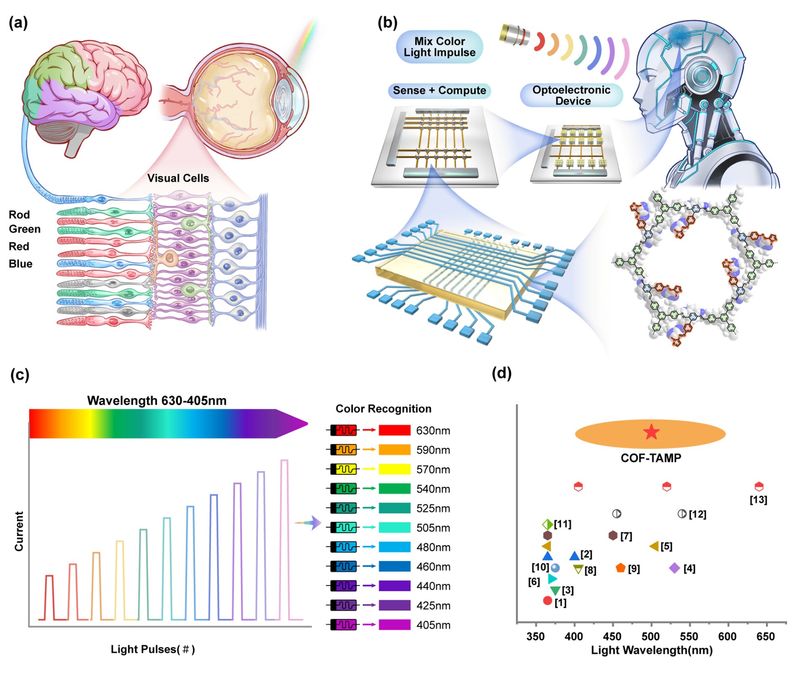
Organic optoelectronic synapse devices have attracted extensive attention in recent years due to their great potential for visual information recognition and processing in artificial visual systems. Different from the human visual system, which can simultaneously perceive light intensity as well as light of red, green and blue at distinct wavelengths, traditional photosensitive elements can only detect incident light intensity and lack inherent wavelength selectivity. This drawback makes it difficult for them to process color information.
To address this challenge, researchers have begun to explore organic optoelectronic materials that integrate wavelength discrimination capability into optoelectronic synapse devices, aiming to realize the recognition of complex mixed-color visual inputs.
In this work, the team reported an optoelectronic synapse device based on pyrazole-azobenzene covalent organic framework (COF-TAMP). Experiments revealed that when subjected to light pulses with wavelengths ranging from 405 nm to 630 nm, the pyrazole-azobenzene structure in COF-TAMP undergoes gradual cis-photoisomerization. Consequently, the device achieves at least 20 distinguishable conductance states under 11 different wavelengths across the visible spectrum.
However, fabricating organic materials into nanoscale thin-film synapse devices with chip-level precision has long been a tough challenge, which mainly lies in ensuring microscopic uniformity and stability. Two-dimensional covalent organic frameworks (COFs) possess prominent advantages over other organic materials. Featuring stable crystal structures similar to conventional semiconductors, COFs guarantee excellent microscopic uniformity of devices in practical applications.
The optoelectronic synapse device array with multi-wavelength response capability developed by the team shows broad application prospects in artificial visual systems. It is expected to solve the color distortion problem in current image processing and provide a brand-new technical route for the perception of mixed-color information.
This research was completed by Lei Zhao, a PhD candidate from the School of Chemistry, under the guidance of Professor Bin Zhang and Professor Fuzhen Xuan of the Institute of Intelligent Sensing and Instruments. The research was supported by the National Natural Science Foundation of China for Innovative Research Groups, the National Key R&D Program of China and the Collaborative Innovation Construction Project of Shanghai Municipal Education Commission.