 12 Aug 2026
Recently, the journal Accounts of Materials Research published an article titled “Anisotropic Single-Crystalline Ti-Based Oxides for Photocatalytic Water Splitting,” reporting the latest progress by the Clean Energy Materials and Devices team from the School of Materials Science and Engineering at ECUST.
The article focused on the synthesis and facet engineering strategies of anisotropic single-crystalline Ti-based oxides, discussed the structure–activity relationships between structural anisotropy and photocatalytic water splitting performance, and summarized advances in single-particle characterization techniques.
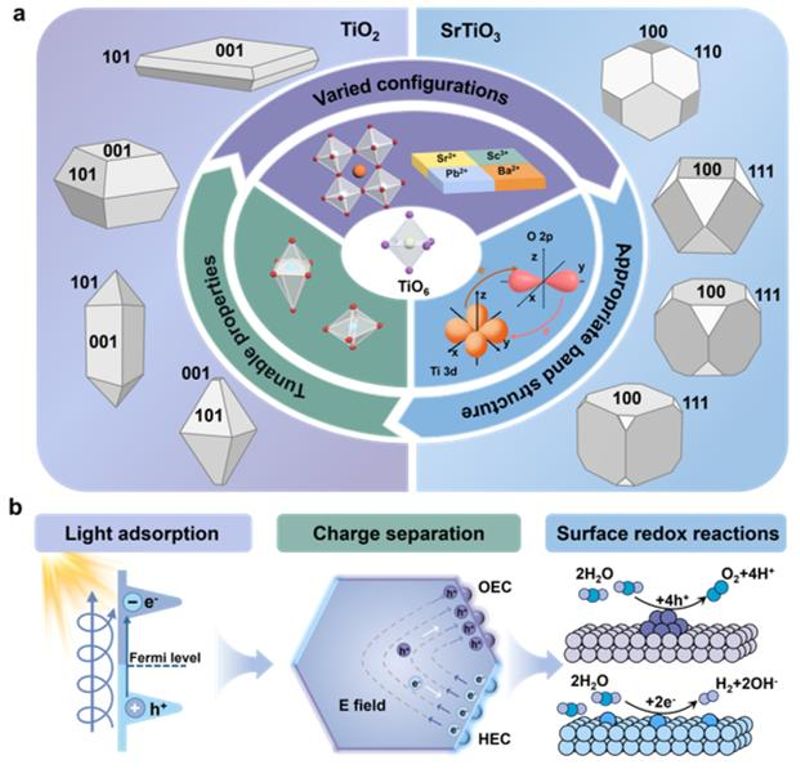
Ti-based oxides such as TiO₂ and SrTiO₃ are classical photocatalysts. However, their performance is limited by rapid recombination of photogenerated charge carriers, low charge migration efficiency, and the spatial overlap of hydrogen and oxygen evolution sites.
After years of research, the team proposed a strategy to enhance photocatalytic water splitting through precise control of facet anisotropy. Unlike traditional approaches based on composition tuning, defect engineering, or heterojunction construction, this strategy uses well-defined single-crystalline materials to control the exposure ratio and spatial distribution of different crystal facets.
Facet anisotropy can promote the directional migration of photogenerated electrons and holes, enabling spatial separation of the hydrogen evolution and oxygen evolution sites. Taking the typical Ti-based oxides TiO₂ and SrTiO₃ as model systems, the team, guided by Wulff theory and other crystal growth theories, developed hydrothermal/solvothermal synthesis, molten salt methods, and regulation approaches involving inorganic ions, organic small molecules, and heteroelement doping.
For TiO₂, early work achieved high-ratio exposure of the highly active {001} facets of anatase through surface energy regulation. By regulating the exposure ratios of facets such as {100}, {110}, and {111}, differences in surface structure and energy-level distribution among different facets could generate built-in electric fields that directed the directional migration of photogenerated electrons and holes.
Combined with selective loading of cocatalysts, spatial separation of hydrogen and oxygen evolution sites could be realized at the single-particle level. The optimized Al-doped SrTiO₃ single-crystal system exhibited excellent activity and stability in pure water splitting.
In addition, this Account summarized advanced characterization methods, including single-particle fluorescence imaging, Raman microscopic imaging, and surface photovoltage microscopy, providing guidance for probing the spatial distribution, migration behavior, and local reactivity of charge carriers at the single-particle level.
This work was mainly completed by Ph.D. candidate Mengmin Wang from the School of Materials Science and Engineering under the supervision of Prof. Huagui Yang. The research was supported by the National Key Research and Development Program of China and the Shanghai Pilot Program for Basic Research.