 05 Aug 2026
Recently, the journal Nano Letters has reported new progress from ECUST in water electrolysis for hydrogen production. The work by the Clean Energy Materials and Devices team from the School of Materials Science and Engineering is published under the title “CeO₂ Stabilized Ni₄Mo Alloys as Robust Alkaline Hydrogen-evolving Electrocatalysts for Anion Exchange Membrane Water Electrolysis”.
Water electrolysis is an important route to green hydrogen using renewable electricity, and anion exchange membrane water electrolysis (AEMWE) shows favorable prospects for large-scale applications owing to its low-cost materials and compact structures.
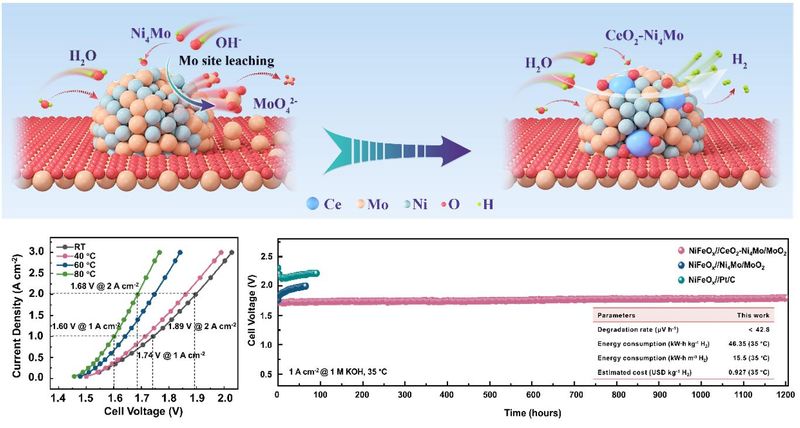
Nevertheless, non-precious metal cathodes still confront the challenge of reconciling activity and stability at ampere-level current densities. Although NiMo-based alloys possess excellent hydrogen evolution activity in alkaline electrolytes, they undergo severe Mo leaching and surface reconstruction during long-term operation, leading to the loss of active sites and deteriorated device performance.
To address this issue, the team proposed a surface passivation strategy using CeO₂-stabilized Ni₄Mo alloys and constructed a CeO₂–Ni₄Mo/MoO₂ self-supported cathode, in which Ni₄Mo served as the primary active phase, CeO₂ as a passivation layer, and MoO₂ as the skeleton. The team revealed that CeO₂ suppresses hydroxide-induced Mo dissolution and helps maintain the reduced state of Ni and Mo, mitigating structural degradation. The cathode delivered 1.0 A cm⁻² at an overpotential of ~165 mV in 1 M KOH and sustained hydrogen production for more than 3000 h at 500 mA cm⁻².
In a platinum-group-metal-free AEMWE system, it achieved 2.0 A cm⁻² at 1.68 V at 80 °C and operated stably for 1200 h at 1.0 A cm⁻² with a degradation rate below 42.8 μV h⁻¹. This work offered a new strategy for AEMWE cathodes combining high activity and stability, with significant implications for reducing hydrogen production costs and advancing the green hydrogen industry.
This research was primarily conducted by master’s student Yaoren Mo, under the guidance of Professor Huagui Yang and Associate Professor Pengfei Liu, with support from the Key Project of the National Natural Science Foundation of China and the Shanghai Basic Research Special Zone.
原文链接:https://news.ecust.edu.cn/2026/0805/c8a202532/page.htm