 24 Jul 2026
Recently, a research team led by Professor Yongshu Xie and Associate Professor Qizhao Li from the Feringa Nobel Prize Scientists Joint Research Center, School of Chemistry and Molecular Engineering at ECUST, published an article titled “Triply N-Confused Hexaphyrins (1.1.1.1.1.0) Synthesized From N-Confused Hexaphyrin (2.1.1.1.1.1): Aromaticity Modulation, Metal Coordination, and Photothermal Conversion” in Angewandte Chemie International Edition, reporting the latest progress in antiaromatic porphyrinoid synthesis and photothermal conversion.
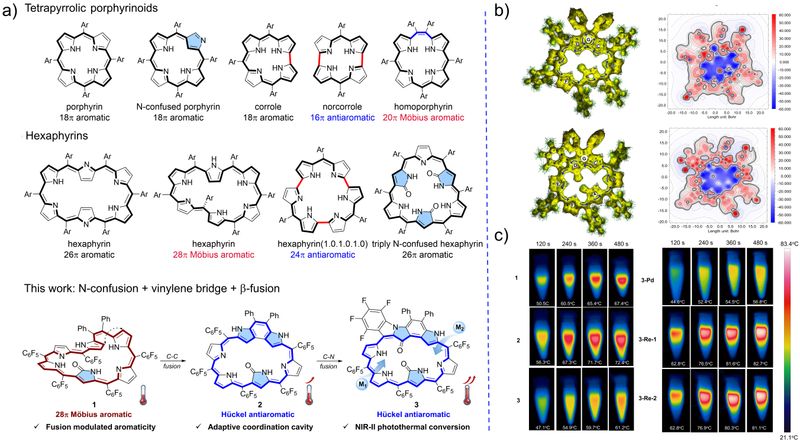
Building on previous antiaromatic porphyrinoid work (Angew. Chem. Int. Ed. 2023, 62, e202212174; CCS Chem. 2023, 5, 1332; J. Am. Chem. Soc. 2025, 147, 5368; J. Am. Chem. Soc. 2025, 147, 28161), the team introduced an N-confused pyrrole unit into the hexaphyrin framework, forming multiple intramolecular hydrogen bonds to enhance molecular stability. Adding a meso-carbon atom modulated conjugated electrons and conformation, yielding the 28π Möbius aromatic meso-expanded N-confused oxohexaphyrin 1. The spatial proximity of two pyrrole units in 1 enabled oxidative Cβ–Cβ fusion, affording compound 2 with 24π/28π Hückel antiaromaticity. Under basic and heating conditions, 2 underwent further C–N fusion with the adjacent C6F5 moiety to yield the N-confused dioxohexaphyrin 3 containing a [5.6.5.5.6]-pentacyclic fused ring system (Figures a, b).
Compound 3 exhibited varied coordination properties: reacting with Re2(CO)10 yielded two distorted mono-Re(I) complexes, while reaction with Pd(OAc)2 produced a mono-Pd(II) complex. Further coordination afforded the heterobimetallic complex 3-O-Pd-Re. Antiaromaticity and metal coordination can promote nonradiative decay in the excited state, while the resulting complexes show distinct NIR-II absorption. Under 1064 nm laser irradiation, these complexes exhibited high photothermal efficiency (Figure c). This work constructs antiaromatic porphyrinoid molecules, laying a foundation for the application of antiaromatic molecules in photothermal diagnosis and therapy.
The study was primarily conducted by ECUST postdoctoral fellow Gaojie Zhu under the supervision of Professor Yongshu Xie and Associate Professor Qizhao Li, with guidance from Academician He Tian. Collaborators including Professor Jianzhuang Jiang (University of Science and Technology Beijing) and Dr. Glib Baryshnikov (Linköping University) provided support in mechanistic studies, crystal structure analysis, spectroscopy, and theoretical calculations.
Funding was provided by the Key Program, General Program, and Young Scientists Fund of the National Natural Science Foundation of China, the Shanghai Rising-Star Program, the Shanghai Pujiang Program, the Natural Science Foundation of Shanghai, the Frontiers Science Center for Materiobiology and Dynamic Chemistry (MOE), and the Shanghai Science and Technology Major Project.