 06 Aug 2026
Recently, the 2025 Shanghai Science and Technology Conference and the 2025 Shanghai Science and Technology Awards Ceremony was held. As the first completing institution, ECUST received commendations for 17 achievements, including 9 first prizes, 6 second prizes, 1 Youth Science and Technology Outstanding Contribution Award, and 1 International Science and Technology Cooperation Award.
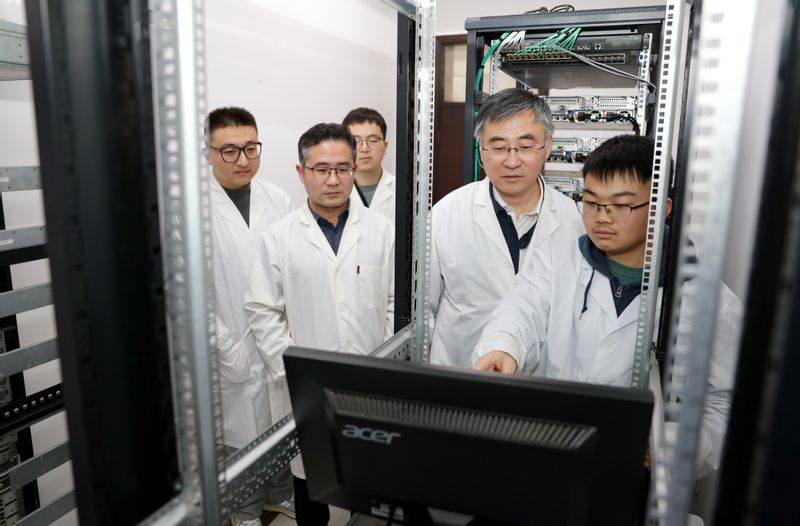
The development of the aerospace sector demanded lightweight, high-strength, and high-temperature-resistant materials. Rigid polymers could meet this demand, but the presence of rigid motifs significantly increased the difficulty of their synthesis and preparation. Supported by the Ministry of Science and Technology’s “863” Program and the National Natural Science Foundation of China, after 20 years of joint research, the team created two new classes of materials, poly(p-phenylene-2,6-benzobisoxazole) (PBO) and rigid motif-containing arylacetylene resins, and achieved their engineering and equipment deployment.
First, the team invented synthesis technology for rigid motif-containing polymers. Addressing the challenges of molecular weight enhancement and structural control of PBO, they revealed the polymerization mechanism and prepared high-molecular-weight PBO with a controllable structure. Its fiber tensile strength reached 5.8 GPa and tensile modulus 270 GPa, matching the level of international counterparts and breaking the technological blockade.
Second, they established preparation processes and equipment. By developing the phase behavior theory of liquid crystalline polymers, they built China’s first two-stage integrated polymerization-spinning PBO fiber production facility. They also invented a resin curing optimization technology, achieving a 5% thermal decomposition temperature of 650°C and raising the short-term service temperature of composite matrices to 600°C.
Third, they established a data-driven method for polymer design and preparation. To realize the structure-function integration of rigid polymers, they moved beyond the trial-and-error approach and created a series of new resins, including high-temperature-resistant, low-dielectric silicon-containing arylacetylene resins and high-thermal-conductivity, easily processable silicon-containing arylacetylene imide resins. They built China’s first data-driven polymer design platform, applied in 68 institutions and greatly improving R&D efficiency.
The project has been granted 47 invention patents and 9 software copyrights, published 54 papers, and has been applied in 6 major equipment programs.