 29 Jul 2026
Recently, the 2025 Shanghai Science and Technology Conference and the 2025 Shanghai Science and Technology Award Ceremony was held. As the primary completing institution, ECUST received a total of 17 awards, including 9 first prizes, 6 second prizes, 1 Youth Outstanding Science and Technology Contribution Award, and 1 International Science and Technology Cooperation Award.
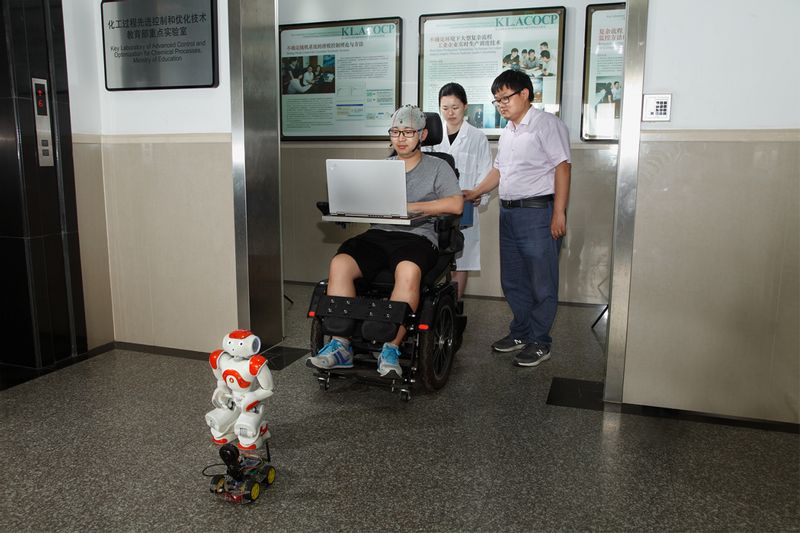
As an important frontier in next-generation human-computer interaction, brain-computer interface (BCI) technology has strategic significance for applications such as motor assistance, functional rehabilitation, and the assessment and modulation of disorders of consciousness. Non-invasive BCIs, known for their high safety and applicability, are considered a key pathway to large-scale application. However, signal redundancy, insufficient task feature representation, and limited decoding efficiency have long constrained their application.
Addressing global scientific frontiers and national strategic needs, the project focused on key bottlenecks in non-invasive BCIs for rehabilitation. The team systematically investigated neural signal decoupling, task-related information representation, and cross-subject model generalization, generating original and highly translational value.
To address signal source mixing and noise susceptibility, the project drew on neurophysiological mechanisms to overcome the limitations of traditional methods that rely heavily on global information and linear representations, improving the separability and stability of task-related signals. To address temporal variations and feature misalignment, the project revealed dynamic patterns of task-related neural activity, moving beyond static temporal assumptions to reduce non-task-related interference and enhance system robustness.
To address high sample requirements, individual variability, and calibration costs, the project established a modeling framework balancing group commonalities and individual differences. The resulting framework maintains stable decoding performance while significantly reducing sample requirements and calibration costs, supporting the transition of BCIs from subject-specific systems toward more generalizable applications.
Five representative papers were published in CAS Tier-1 journals or leading BCI journals, including four ESI Highly Cited Papers and one ESI Hot Paper. The research received recognition from academicians and professional society fellows in China, the United States, and Europe. The findings were selected for the “Hua’nau: Top 10 BCI Advances in China for 2024,” reported by CCTV and other mainstream media, and recognized with top prizes in multiple national BCI competitions, helping advance the clinical application and industrialization of BCI technology. This is the first time the Shanghai Science and Technology Award's First Prize has been given specifically for brain-computer interfaces, and this work was also named to Hua’nau’s Top 10 BCI Advances in China for 2024.