 20 Aug 2026
Recently, the research team focusing on clean energy materials and devices from the School of Materials Science and Engineering at ECUST made new progress in the field of one-dimensional hybrid metal halide semiconductors. The findings, titled “One-Dimensional Hybrid Lead Halide Crystals with Molecular Pb-N Coordination for High-Performance Radiation Detection”, were published in Nano Letters.
Low-dimensional hybrid metal halides have attracted considerable interest due to their structural diversity and excellent photophysical properties, showing important application prospects in radiation detection, solar cells, and light-emitting diodes. However, in conventional hybrid materials, the organic and inorganic components are connected through weak ionic bonds and hydrogen bonds, leading to insufficient structural stability and limited carrier transport, which restricts their practical applications in electronic devices. How to strengthen the coupling between organic and inorganic components at the molecular level to achieve effective suppression of ion migration and synergistic enhancement of charge transport remains a key scientific challenge in this field.
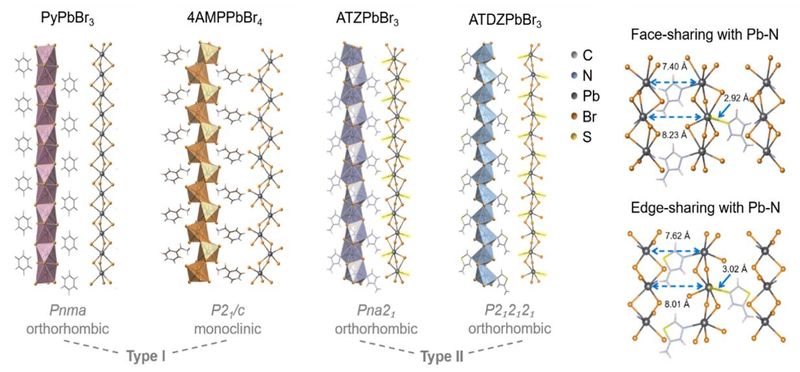
To address this challenge, the research team introduced organic molecules with multidentate coordination capability. By constructing Pb-N coordination bonds to lock the organic-inorganic interface, the team successfully developed a new class of one-dimensional hybrid lead halide crystalline materials. Theoretical and experimental studies reveal that the formation of Pb-N coordination bonds imparts covalent characteristics to the organic-inorganic interface. This not only shortens the interchain distance of inorganic chains and enhances structural rigidity, but also enables organic cations to directly participate in charge transport through electronic orbital hybridization, addressing the conventional limitation that organic components in conventional low-dimensional materials serve merely as insulating spacers.
X-ray detectors assembled based on this material exhibit outstanding radiation detection performance. The ATDZPbBr₃ polycrystalline device achieved a detection sensitivity of 1.63 × 10⁴ μC Gyₐᵢᵣ⁻¹ cm⁻² and a low detection limit of 19.7 nGy s⁻¹, surpassing commercial amorphous selenium (α-Se) and cadmium zinc telluride (CdZnTe) traditional X-ray detection materials. In addition, the device maintained excellent stability under continuous X-ray irradiation for 2000 s.
ECUST is the sole corresponding institution of this paper. Yuhao Zhao, a master’s student from the School of Materials Science and Engineering, is the first author. The corresponding authors are Professor Shuang Yang, Professor Huagui Yang, and Professor Yu Hou. The research was supported by the National Key Research and Development Program of China, the National Natural Science Foundation of China, the Ministry of Education Program for Supporting the Research and Innovation Capabilities of Young Faculty at Central Universities, and the Shanghai Pilot Program for Basic Research.