 31 Jul 2026
Recently, Professor Nianfeng Wan’s research team from the School of Pharmacy at ECUST, in collaboration with 178 researchers from 145 institutions across 38 countries, published a research article titled “Plant Diversity Modifies Multi-trophic Interactions in Croplands, Grasslands and Forests” in Science Advances, a journal under Science. This study provides the first global-scale systematic analysis of how plant diversity regulates multi-trophic interactions through distinct ecological mechanisms, revealing fundamental differences among croplands, grasslands, and forests.
Plant diversity plays a critical role in shaping ecosystem food webs, yet how it regulates ecological interactions remains unclear. This study investigated whether the effects of plant diversity are primarily mediated by top-down control through natural enemies or bottom-up regulation through resource availability, and how the relative importance of these mechanisms varies across ecosystems.
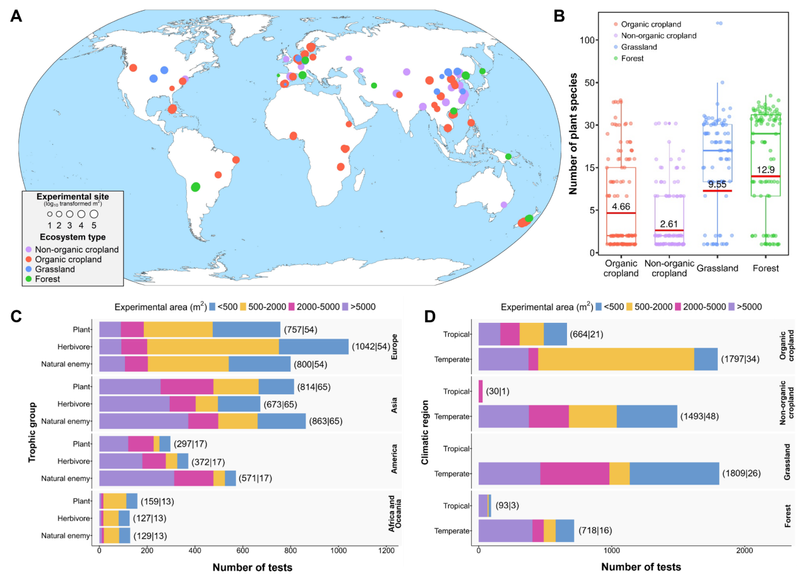
To address this question, Professor Wan initiated and led a global collaborative study involving 149 field experimental sites across five continents. By integrating long-term observational data from diverse ecosystems, including organic croplands, conventional croplands, grasslands, and forests, the research team examined the general patterns and ecosystem-specific mechanisms underlying plant diversity-mediated regulation of multi-trophic interactions.
The findings revealed distinct ecological mechanisms across ecosystem types. In croplands, increased plant diversity strongly enhanced top-down ecological control by promoting natural enemy communities. Plant diversification significantly increased the ratio of predators and parasitoids to herbivores, with average increases of 846% in organic croplands and 148% in conventional croplands. These results demonstrate that biodiversity-based management practices, such as intercropping and cover cropping, can strengthen natural pest suppression and reduce reliance on chemical pesticides.
In contrast, plant diversity in grasslands and forests primarily regulated ecosystems through bottom-up resource effects. Increased plant diversity enhanced overall plant productivity, providing greater resource availability and supporting simultaneous increases across multiple trophic levels, from herbivorous insects to predators and parasitoids. Unlike croplands, where diverse plants selectively enhance natural enemy-mediated pest control, natural ecosystems benefit mainly from broader resource enrichment.
Further analyses using linear regression and mixed-effects models confirmed that ecosystem type significantly influenced the relationships among plant productivity, herbivores, and natural enemies. The results showed that top-down regulation dominated in croplands, whereas bottom-up effects prevailed in grasslands and forests.
This study provides guidance for ecosystem management. In agricultural systems, promoting plant diversity can enhance ecological pest control and support sustainable pest management. In natural ecosystems, maintaining plant diversity can improve ecosystem productivity while simultaneously supporting biodiversity conservation and ecological functions.
ECUST is the first completion institution and the sole corresponding institution for this paper. Professor Nianfeng Wan is the corresponding author and co-first author. Other co-first authors include postdoctoral researcher Muyao Li from Shanghai Jiao Tong University, Shisiyuan Shen from Fudan University, and doctoral students Junxiang Zhou and Yutong Zhu from Professor Wan’s research team. Researchers from multiple institutions worldwide contributed experimental data to this study. The research was supported by the General Program of the National Natural Science Foundation of China, as well as projects funded by the Shanghai Municipal Agriculture and Rural Affairs Commission and Shanghai Science and Technology Commission.
原文链接:https://news.ecust.edu.cn/2026/0725/c8a202432/page.htm