 11 Aug 2026
Recently, the team led by Professor Qiang Yang and Associate Professor Bo Liu from the Key Core Technology Integrated Research Platform for Green Manufacturing and Utilization of Hydrogen Energy at ECUST, in collaboration with the team of Assistant Professor Huanshu Tan from Southern University of Science and Technology, has made new progress in the field of two‑phase flow and bubble regulation for high‑current‑density water electrolysis hydrogen production.
The work was covered by EurekAlert of the American Association for the Advancement of Science and published in the journal eScience (IF: 52.9) under the title “Coalescence-induced late departure of bubbles improves water electrolysis efficiency”, as the front cover article.
Green hydrogen was an important energy carrier for deep decarbonization, and reducing the energy consumption of water electrolysis was key to its large-scale application. Hydrogen bubbles formed during electrolysis blocked active sites, increased mass transfer resistance, and lowered efficiency. It was long believed that smaller and earlier bubble departure was better.
The study broke this traditional view. The team found that at high current densities, fine bubbles on the electrode were the primary factor blocking reaction sites. Promoting bubble coalescence enabled larger departing bubbles to capture and carry away these fine bubbles, freeing active sites and improving mass transfer. Coalescence-prone systems, despite producing larger bubbles, reduced energy loss by up to 30% in both acidic and alkaline media.
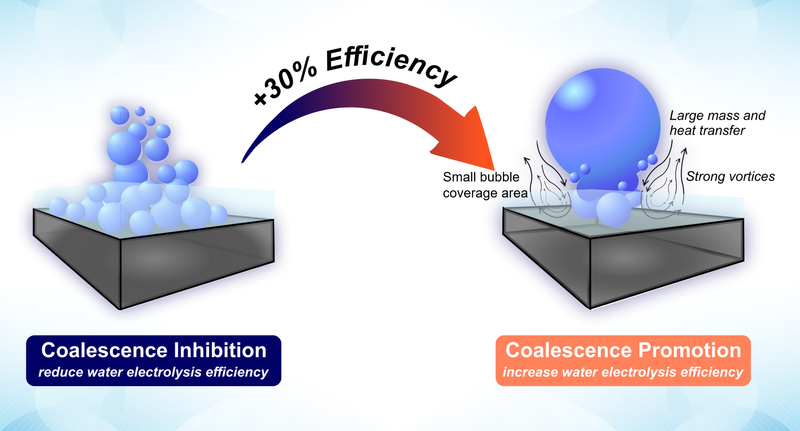
The team further proposed a “coalescence-induced delayed departure” mechanism. Just-detached large bubbles lingered near the electrode, continuously capturing surface micro-bubbles and freeing active sites, while inducing strong local flow that enhanced mass and heat transfer. Since industrial water electrolysis relied on alkaline electrolytes, which naturally inhibited bubble coalescence, this might have been a long-overlooked factor limiting alkaline electrolysis efficiency.
By introducing superhydrophobic polystyrene microparticles into the NaOH system, the team promoted bubble coalescence, lowering the electrolysis potential and improving efficiency by about 2%-6%. This work also provides new insights into other gas-evolving electrochemical processes.
Tao Wu, a PhD candidate, and Associate Professor Bo Liu are the co-first authors. Professor Qiang Yang, Associate Professor Bo Liu, and Assistant Professor Huanshu Tan are the co-corresponding authors. ECUST is the primary affiliated institution. The research was supported by the Key Core Technology Integrated Research Platform for Green Manufacturing and Utilization of Hydrogen Energy and the National Natural Science Foundation of China.