
 16 Sep 2026

Recently, Academician Weihong Zhu and Professor Zhiqian Guo from the School of Chemistry and Molecular Engineering, together with Professor Yisheng Xu from the School of Chemical Engineering at ECUST, proposed an original “monomeric state-aggregated state” decoupling strategy, offering a new direction for NIR-II theranostics.
Based on kinetic assembly principles, the strategy leveraged the synergistic regulation of polymers and proteins to achieve the precise decoupling of fluorescence imaging and photothermal conversion signals within a single-component nanoplatform, effectively addressing the challenge of “spectral crosstalk” and providing a new approach for efficient, long-lasting, and personalized tumor diagnosis and treatment.
The findings, titled “Kinetic-Assembly Tuning NIR-II Cyanine Aggregated States: Remarkable Photothermal-Mediated Sustained Retention in Orthotopic Hepatoma,” were published in Science Advances.
NIR‑II fluorescence imaging offers deep tissue penetration and low autofluorescence, while photothermal therapy provides spatiotemporal controllability and noninvasiveness. However, combining the two presents a challenge: the aggregated state of dyes enables efficient photothermal conversion but causes fluorescence quenching, whereas the monomeric state provides strong fluorescence but has limited photothermal efficiency. Conventional compositing strategies cannot avoid energy competition between components, leading to mutual constraints between imaging and therapy.
To address this challenge, the research team proposed a “one molecule, two states” design concept: the monomeric state of the same NIR-II cyanine dye was responsible for fluorescence imaging, while the aggregated state handled photothermal conversion, fundamentally eliminating energy competition at the chemical level. To achieve precise regulation of the two states, the team introduced proteins as aggregation sites, combining kinetically driven flash nanoprecipitation (FNP) with temperature-responsive block copolymer co-assembly to precisely regulate the formation of aggregated and dispersed states of DQP dyes within nanoparticles. Through this elegant “one core, two states” design, the prepared DQP NPs achieved dual functions of imaging and therapy simultaneously: under 808 nm laser excitation, the aggregated state enabled efficient photothermal conversion; under 980 nm laser excitation, the monomeric state emitted strong NIR-II fluorescence, thereby avoiding the mutual constraints of spectral crosstalk in conventional systems.
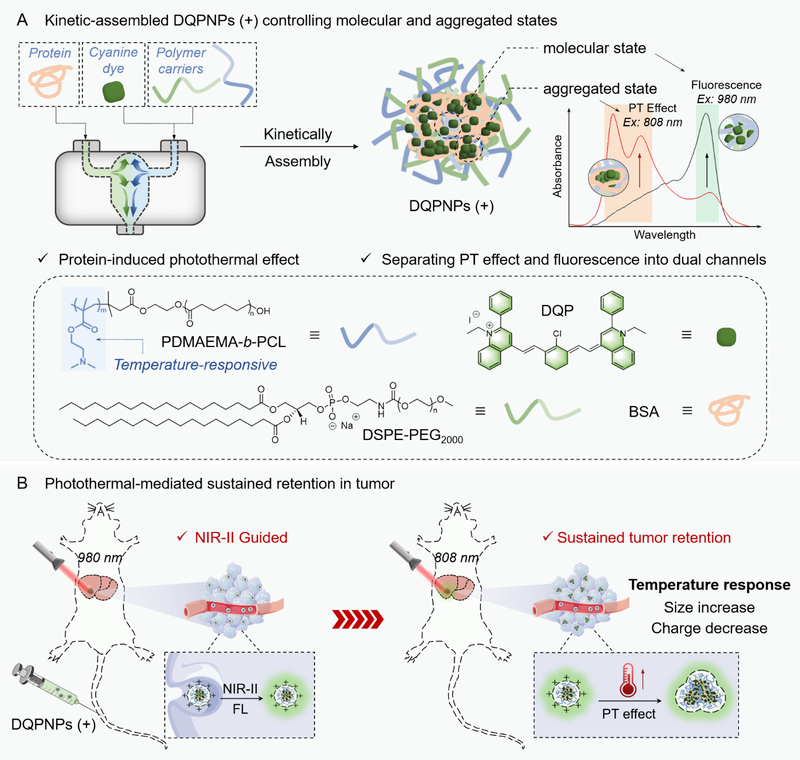
In an orthotopic hepatoma model, NIR‑II fluorescence signals at the tumor site increased by 13.4‑fold, and the tumor inhibition rate improved by 6.7‑fold. The efficient photothermal conversion driven by strong π-π stacking in the aggregated state could also serve as an endogenous “thermal trigger switch.” Local heating induced hydrophilicity-hydrophobicity changes in the temperature‑responsive block copolymer, which prompted a decrease in nanoparticle surface charge and in‑situ size enlargement. This photothermal‑mediated charge and size transformation extended the tumor retention time of the nanoparticles by 6-fold, achieving efficient and long‑lasting theranostics.
The first author of this paper is Yue Wu, a postdoctoral fellow from the School of Chemistry and Molecular Engineering at ECUST. Professor Zhiqian Guo and Professor Yisheng Xu are the co-corresponding authors. The research was conducted under the guidance of Academician Weihong Zhu and was supported by the National Natural Science Foundation of China and the Science and Technology Commission of Shanghai Municipality.