 09 Oct 2026

Recently, a team led by Academician He Tian and Professor Xiang Ma at the Feringa Nobel Prize Scientist Joint Research Center, School of Chemistry and Molecular Engineering, ECUST, developed a series of high-performance, multifunctional noncovalent biomolecular glasses exhibiting room-temperature phosphorescence (RTP). The materials combine high transparency, recyclability, and biodegradability. The findings, titled “Noncovalent Biomolecular Glass Platform for Ultralong Room-Temperature Phosphorescence,” were published in Angewandte Chemie International Edition.
Organic phosphorescent materials offer broad prospects in bioimaging, information encryption, and 3D displays owing to their large Stokes shifts, long lifetimes and diverse excited-state behavior. Improving RTP generally requires enhanced intersystem crossing and suppressed nonradiative relaxation. Researchers aim to create rigid protective microenvironments through supramolecular encapsulation, crystal engineering, polymerization and host-guest doping. These microenvironments help immobilize luminophores, stabilize triplet excitons and reduce vibrational relaxation.
Supramolecular glasses offer an attractive yet underexplored platform: these amorphous, isotropic solids combine high optical transparency, solution or melt processability, and molecular design flexibility. Amino-acid-derived supramolecular glasses are especially promising for their abundant feedstocks, biodegradability, biocompatibility and easy functionalization. However, few studies have explored multifunctional biomass-derived supramolecular glasses with high-performance, color-tunable afterglow emission.
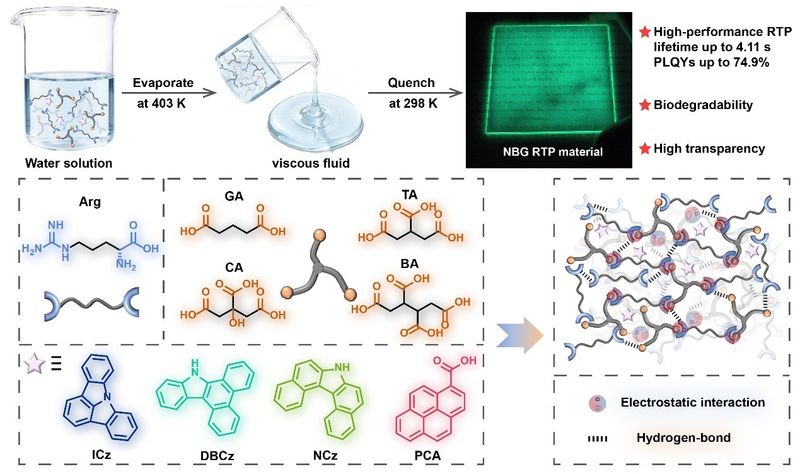
The team constructed glasses from small-molecule amino acids and organic acids through noncovalent interactions. Their dense interaction networks confined embedded luminophores and suppressed nonradiative relaxation, providing rigid hosts for phosphorescence. After embedding different luminophores, the team used rapid solvent evaporation and quenching to obtain doped RTP systems. These systems exhibited color-tunable afterglow spanning 430-610 nm, optical transmittance up to 93%, phosphorescence lifetimes up to 4.11 s, and photoluminescence quantum yields up to 74.9%. Pronounced viscosity changes during glass formation imparted strong and stable adhesion to various substrates. The materials could also be reprocessed reversibly and gradually biodegraded in soil without affecting normal plant growth.
Professor Xiang Ma and Research Associate Professor Liangwei Ma are the corresponding authors of the paper, while PhD candidate Yumo Dong from the School of Chemistry and Molecular Engineering is the first author. The research was guided by Academician He Tian and was supported by the Basic Science Center Program of the National Natural Science Foundation of China, the National Science Fund for Distinguished Young Scholars, and the Fundamental and Interdisciplinary Disciplines Breakthrough Plan of the Ministry of Education of China.