
 08 Oct 2026

Recently, the research team led by Dahui Qu and Fei Tong at the Feringa Nobel Prize Scientists Joint Research Center, School of Chemistry and Molecular Engineering, has made new progress in dynamic photoresponsive molecular crystal materials. The related findings, entitled “Multi-Chamber Dynamic Molecular Crystal Microcapsules for Payload Encapsulation and Controlled Release”, have been published in the Journal of the American Chemical Society (J. Am. Chem. Soc. 2026, doi.org/10.1021/jacs.6c12923).
Molecular self-assembly provides an efficient approach to fabricating organic crystal materials with ordered structures and morphologies. Although considerable progress has been made in controlling crystal morphology regulation, highly tailored organic single crystals, especially those featuring fully enclosed internal cavities, remain extremely rare. Precisely and controllably constructing such crystals still poses substantial challenges.
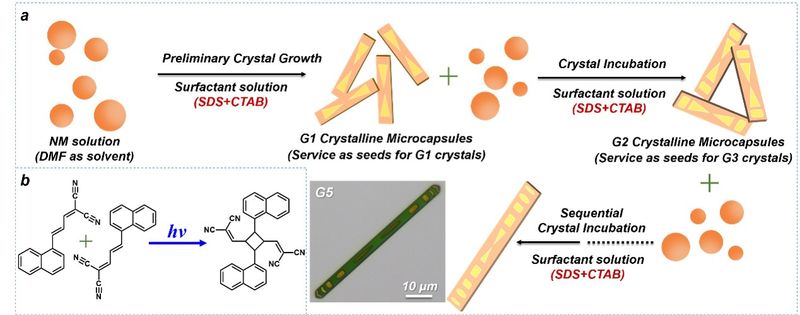
To address these challenges, the team collaborated with the research group of Professor Christopher J. Bardeen from the University of California, Riverside. Based on previous studies, the researchers elucidated the growth mechanism of crystals with multiple enclosed-chamber and established a corresponding theoretical model. They developed an innovative growth method for crystalline microcapsules that enabled precise control over the number and size of internal sealed chambers.
A series of experiments verified that the encapsulated functional components remained completely isolated and could be stored in sealed chambers for more than 200 days without leakage. Upon irradiation with visible light at wavelength of 400-580 nm, photoactive molecules within the crystal lattice underwent [2+2] photocycloaddition (photodimerization), triggering the localized disassembly of specific crystal regions and enabling the controlled release of substances from a single or designated chamber. This work provided a broadly applicable new strategy for the design and fabrication of organic functional crystal materials with complex topological structures.
Lin Chen, a PhD candidate from the School of Chemistry and Molecular Engineering, is the first author. The corresponding authors are Professor Dahui Qu, Associate Professor Fei Tong, Professor Christopher J. Bardeen, and Research Professor Rabih Al-Kaysi. This research was conducted under the guidance of Academician He Tian, and was supported by the National Natural Science Foundation of China and the Shanghai Municipal Commission of Science and Technology.