 14 Sep 2026
Each year, Professor Ping Hu delivers around 300 teaching hours. Textbooks she edited as editor-in-chief have been adopted by nearly 300 universities, and the laboratory center she directs provides over 370,000 student-hours of practical training. These figures reflect her 30-year teaching career at the School of Chemistry and Molecular Engineering, ECUST.
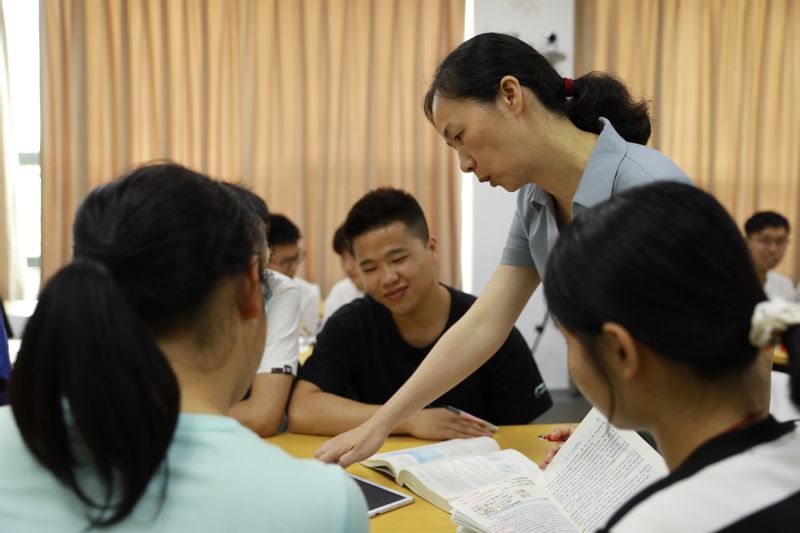
Since joining ECUST in 1995, Hu has always prioritized teaching and student cultivation above all else. As a core member of China’s first Huang Danian-style teacher team, she approached both theoretical and experimental courses with meticulous care, continually refining their content and striving to make every class meaningful to students. She proposed a distinctive teaching philosophy for analytical chemistry: chemical analysis centers on accuracy, while instrumental analysis focuses on information acquisition.
She connected her courses with cutting-edge research, engineering cases, and real-world scenarios. Project-based tasks such as lunar soil analysis effectively stimulated students’ enthusiasm for learning. Her textbooks, including Instrumental Analysis (5th edition) and Analytical Chemistry (7th edition), were listed as national planning textbooks.
For Hu, research and teaching complemented and empowered each other. She led more than 10 national and provincial research projects, undertook over 60 enterprise collaboration projects, obtained or applied for 20 patents, and published over 160 academic papers, over 90 of which were SCI-indexed. She incorporated her research into the classroom and designed comprehensive experiments based on industrial projects, making instrumental analysis vivid and practical.
Hu also integrated research into graduate education, combining theoretical study, experimental exploration, and research innovation. She emphasized scientific integrity and tailored guidance to students’ individual strengths. To date, she has supervised more than 100 master’s and doctoral students and guided eight undergraduate innovation projects, with her students receiving awards in national competitions.
As director of the Chemistry Experiment Teaching Center, Hu led a team serving over 3,800 students from seven schools and more than 30 majors each year, providing more than 370,000 student-hours of experimental training. She helped the center pass national evaluations and promoted smart, comprehensive upgrades. Additionally, she headed a 13-member analytical chemistry teaching team, developing MOOCs and case libraries to enrich online and offline instruction.
Hu was also committed to nurturing young faculty. “She guided me in designing lesson plans and classroom activities, and regularly observed my lectures to offer targeted feedback,” said Qianying Sheng, head of the analytical chemistry teaching group. Another faculty member, Hongyang Zhang, noted that Hu always put teaching first, even when busy.
“Studying under Prof. Hu was one of the greatest blessings of my academic journey,” said Linghao Zhao, a PhD graduate. “She respected our choices and gave us the courage to explore.”
Hu remarked that she would keep innovating teaching methods and uphold her original aspiration for education. Her story is a testament to lifelong devotion to education.