 15 Sep 2026

Recently, the team led by Professor Dahui Qu and Associate Professor Ruirui Gu from the Feringa Nobel Prize Scientist Joint Research Center, School of Chemistry and Molecular Engineering, ECUST, made new progress in dynamic combinatorial chemistry. The research, titled “Host-Directed Discovery of Dynamic-Covalent Guests from Dynamic Combinatorial Libraries,” was published in Angewandte Chemie International Edition (2026, e7195803).
Dynamic covalent chemistry enables molecular systems to reorganize through reversible covalent bonds, while host-guest chemistry achieves selective molecular recognition through noncovalent interactions. Integrating these two approaches offers new opportunities for developing adaptive and recyclable smart materials. However, because host-guest binding depends on molecular shape, size, and charge distribution, identifying suitable dynamic-covalent guest molecules has traditionally relied on labor-intensive trial-and-error.
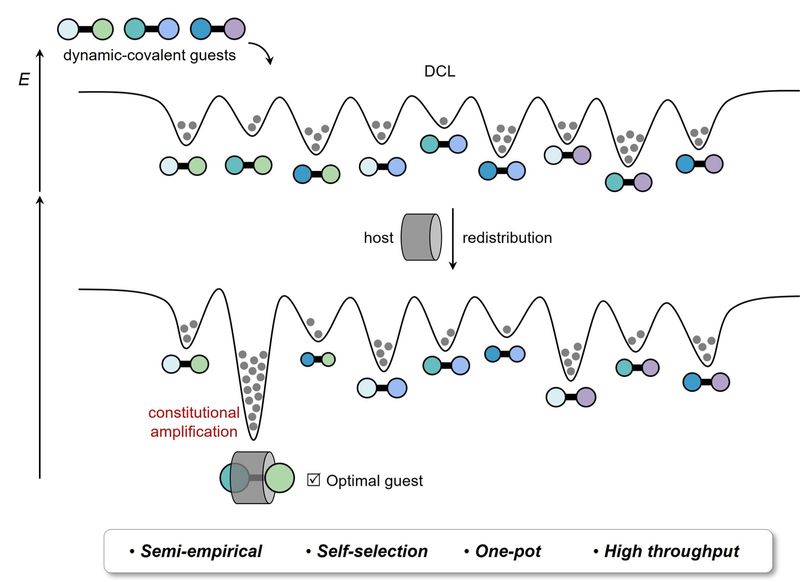
To address this challenge, the ECUST team collaborated with Professor Jean-Marie Lehn’s group at the University of Strasbourg and developed a host-directed screening strategy for dynamic combinatorial libraries. By introducing pillar[5]arene macrocyclic hosts (EtP[5] and MeP[5]OTf) into dynamic imine libraries, the strongest-binding guest molecules were selectively stabilized, shifting the dynamic equilibrium toward their formation. This allowed promising guest candidates to be identified directly by comparing library compositions before and after host addition, eliminating the need to synthesize and evaluate every candidate individually. The strategy was successfully validated across combinatorial libraries of increasing complexity, and the selected guest molecules were further confirmed by 2D NMR spectroscopy, density functional theory calculations, and single-crystal structural analysis.
The study transformed molecular recognition into a dynamic redistribution process within combinatorial libraries, providing a rapid and efficient route for discovering high-affinity guest molecules while substantially reducing screening efforts. Although demonstrated using dynamic imine systems, the strategy is readily extendable to other dynamic covalent chemistries and macrocyclic hosts, offering a versatile platform for the design of adaptive host-guest assemblies and dynamic functional materials.
PhD candidate Zhenye Qiu is the first author of the paper. The corresponding authors are Professor Dahui Qu and Associate Professor Ruirui Gu. The research was conducted under the guidance of Academician He Tian and was supported by the National Natural Science Foundation of China, the Science and Technology Commission of Shanghai Municipality, and the CNPC Innovation Fund.