
 14 Sep 2026

Recently, the journal Advanced Science (Q1, CAS Top Tier, IF=14.1) published the latest research from Professor Liming Zhao’s team at ECUST on the regulation of the gut microbiota by functional oligosaccharides. The paper, entitled “Oligosaccharides with Defined Glycosidic Bonds Shape Gut Microbial Succession and Metabolism via Bond-Specific Microbial Responders” (DOI: 10.1002/advs.77488), investigated the relationship between the structures of functional oligosaccharides and the gut microbiota.
Using five structurally defined glucose disaccharides as model compounds, the researchers integrated absolute time-series profiling, Bayesian generalized Lotka-Volterra (gLV) modeling, metabolomics, metaproteomics, and synthetic microbial communities (SynComs) to reveal how glycosidic bond structures shaped selective microbial responses, microbial succession, and metabolic differences. The findings provide a theoretical basis for the structure-guided design of functional oligosaccharides and the precise modulation of the gut microbiota.
Functional oligosaccharides are important dietary bioactive compounds for regulating the gut microbiota, and their biological functions are closely related to monosaccharide composition, degree of polymerization, and glycosidic bond type. However, naturally occurring oligosaccharides often differ in multiple structural features simultaneously, making it difficult to isolate the specific contribution of glycosidic bond structures. In addition, most previous studies focused on endpoint microbial composition, often overlooking the dynamic process of microbial succession during substrate utilization.
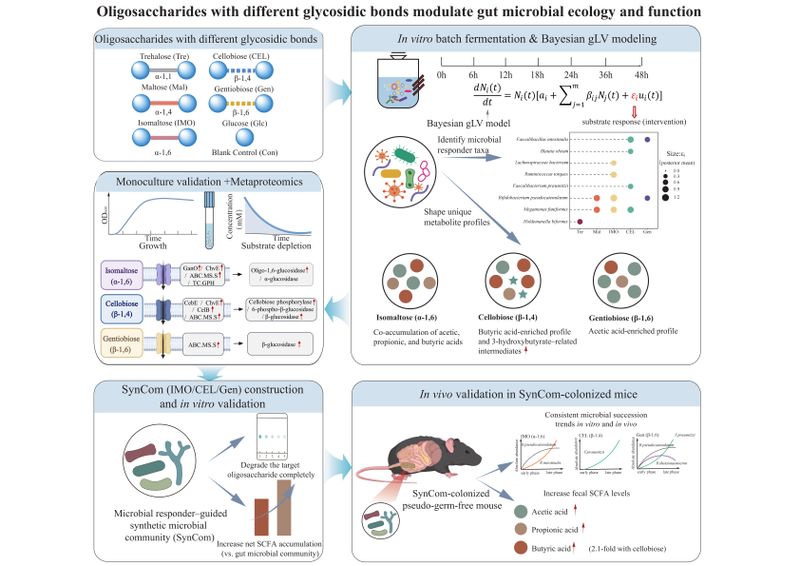
Using five structurally defined glucose disaccharides, the researchers demonstrated that different glycosidic bonds induced distinct patterns of microbial succession and short-chain fatty acid (SCFA) production. α-linked disaccharides mainly promoted recruited Bifidobacterium pseudocatenulatum and Megamonas funiformis, while β-linked disaccharides selectively enriched different microbial taxa and generated distinct metabolic profiles. By integrating time-series ecological modeling with monoculture validation and metaproteomic analysis, the team identified glycosidic bond-specific microbial responders and provided molecular evidence for their selective substrate utilization.
Guided by these findings, they further constructed microbial responder-guided synthetic microbial communities that recapitulated glycosidic bond-specific microbial succession and metabolic outputs. The study provides new insights into how glycosidic bond structures govern gut microbial ecology and offers a foundation for the rational design of functional oligosaccharides for precise microbiome modulation.
The first author of the paper is Dr. Xiaoxuan Lu, a postdoctoral fellow at ECUST. The corresponding authors are Professor Liming Zhao, Associate Professor Jiayang Jin, and Research Associate Professor Xiaoguo Ji. The research was supported by the Young Scientists Fund of the National Natural Science Foundation of China (32302102), the Shanghai Natural Science Foundation (23ZR1415400), and the Shanghai Sailing Program (23YF1409800).