 11 Sep 2026

Recently, a study on organic-inorganic hybrid perovskites by the Clean Energy Materials and Devices Team at the School of Materials Science and Engineering was published in Nature Communications, titled “Deprotonation-mediated Vitrification of Organic-inorganic Hybrid Perovskites”. The work proposed a general flux-mediated strategy to establish a library of high-quality organic-inorganic hybrid perovskite glass materials, covering diverse organic molecules, metal centers and framework dimensionalities.
Organic-inorganic hybrid perovskite glasses represent an emerging class of amorphous semiconductor materials featuring versatile compositional tunability and favourable processability, promising a wide range of applications. Nevertheless, conventional melt-quenching methods are only applicable to a small subset of perovskite crystals. Most materials undergo irreversible decomposition prior to melting, which restricts the scope of perovskite materials amenable to vitrification.
To address this challenge, the team put forward a strategy to modulate intermolecular interactions in perovskites via deprotonation. Partial deprotonation of amine cations induced by alkali metal hydroxides weakens intermolecular forces and reduces melting enthalpy, thereby enabling low-temperature melting.
This strategy lowered the melting points of eight perovskite systems by approximately 21-77 °C, demonstrating good universality. Two originally non-meltable materials, (BA)₂PbI₄ (BA = n-butylamine) and (DGA)PbI₄ (DGA = biguanide), were successfully melted and vitrified. The reduced processing temperature facilitated the fabrication of high-quality perovskite glasses without substantial degradation of their physical properties.
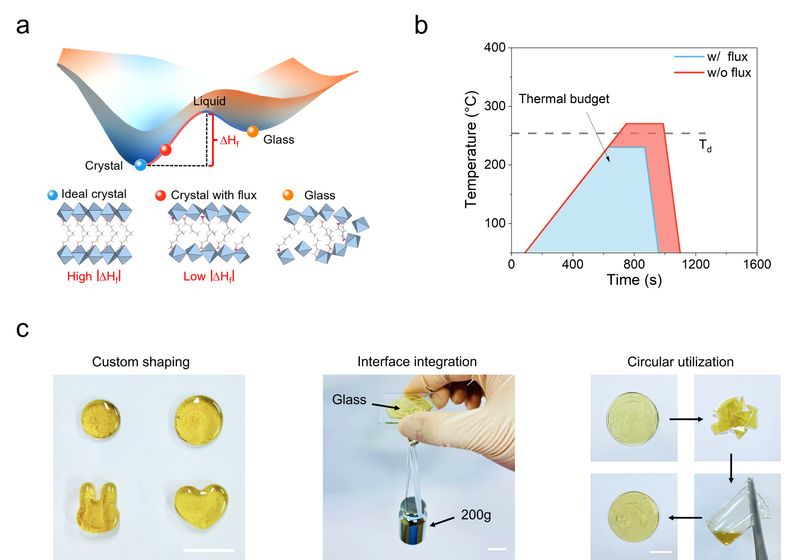
Furthermore, the team fabricated X-ray detectors using (DGA)PbBr₄ glass. Under an electric field of 500 V mm⁻¹, the device achieved a detection sensitivity of 35674.1 μC Gyₐᵢᵣ⁻¹ cm⁻². The material can be deposited onto commercial thin-film transistor arrays via co-melting to realise high-resolution X-ray imaging. Its detection performance remained largely stable after repeated melting cycles.
This study effectively expanded the range of perovskite materials suitable for vitrification and offered new insights into overcoming the thermal decomposition limitation of crystalline phases and enriching the family of perovskite glass materials.
Peng Wang, a PhD candidate from the School of Materials Science and Engineering, is the first author of this paper. Professors Shuang Yang, Huagui Yang and Yu Hou serve as the corresponding authors. This research was supported by the National Natural Science Foundation of China and the Shanghai Pilot Program for Basic Research.