 17 Sep 2026

Recently, six research advances from around the world that could potentially transform the field of drug delivery were reported in Nature Outlook, titled “These six advances could change how drugs are delivered” (Nature, 2026, 657, S2-S3).
An ECUST study entitled “Drug Synergy and Co-delivery Based on Host Defense Peptide-Mimicking Assemblies,” published in Nature Biotechnology (2026, DOI: 10.1038/s41587-025-02930-3), was selected as one of the six advances and received high recognition.
Fungal drug resistance has been increasingly prevalent in recent years, while single-agent antifungal treatments often show limited efficacy or fail altogether. Combinations of two drugs with synergistic effects can be more effective than single-agent treatments, particularly in drug-resistant and difficult-to-treat infectious diseases.
However, systemic fungal infections, especially fungal meningitis, continue to be associated with high mortality rates in clinical settings. One important reason is the limited number of available antifungal drugs, which restricts the number of possible synergistic combinations.
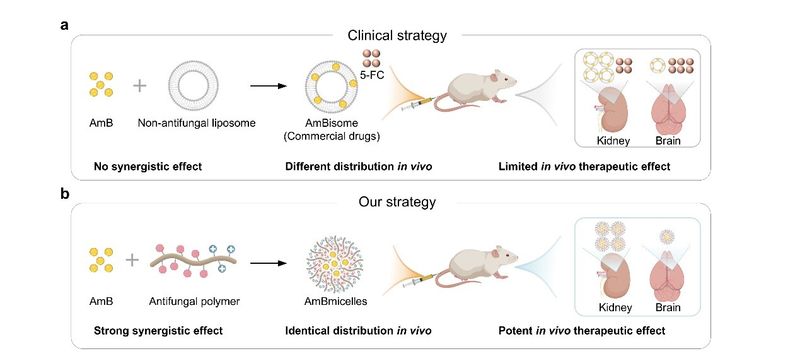
In addition, differences in the pharmacokinetics and in vivo distribution of two drugs can make it difficult for them to reach the site of infection at a synergistic ratio, preventing the synergistic effects observed in vitro from being reproduced in vivo. Effective strategies that can achieve genuine in vivo synergistic effects against drug-resistant fungal infections are therefore urgently needed.
Professor Min Zhou from the School of Materials Science and Engineering at ECUST and her collaborators proposed a strategy for drug synergy and co-delivery based on host defense peptide-mimicking assemblies. The researchers designed and synthesized a peptide polymer that mimics host defense peptides and exhibits strong antifungal activity.
The polymer can act synergistically with amphotericin B (AmB) to achieve enhanced antifungal activity. Meanwhile, the antifungal peptide polymer can self-assemble into nanomicelles capable of encapsulating AmB (AmB micelles), enabling the two antifungal active molecules to be co-delivered in vivo and distributed simultaneously at an optimal synergistic ratio. This strategy substantially reduced the in vivo toxicity of AmB and broadened its therapeutic window.
In addition, the synergistic co-delivery formulation, AmB micelles, exhibited selective fungal-targeting properties, further improving drug utilization. In mouse models of systemic fungal infection and fungal meningitis, AmB micelles demonstrated strong therapeutic efficacy and showed significantly better therapeutic performance than the clinical gold-standard antifungal treatment for fungal meningitis, which combines the antifungal drug AmB liposomes (AmBisome) with flucytosine. The synergistic drug combination co-delivery strategy offers new insights for the treatment of drug-resistant fungal infections.
Dr. Longqiang Liu from the School of Materials Science and Engineering at ECUST, and Professor Min Zhou are the co-first authors of the paper. Professor Runhui Liu is the corresponding author. The research was supported by funding from the National Natural Science Foundation of China and the Ministry of Science and Technology.