
 24 Nov 2026

Recently, the Clean Energy Materials and Devices Team at the School of Materials Science and Engineering, ECUST, developed a strategy for constructing epitaxial heterostructures using flexible, freestanding single-crystal membranes. This strategy enabled lightweight, flexible, self-powered radiation detection. The findings, titled “Triangular-Textured MoS₂/FAPbI₃ Heterojunction Membranes for Lightweight, Flexible, and Self-Powered Radiation Detection,” were published in Nano Letters.
Metal halide
perovskites show considerable promise for radiation detection owing to their
excellent radiation absorption and charge carrier transport properties.
However, conventional devices typically rely on thick, rigid supporting
substrates, making it difficult to achieve both low weight and mechanical
flexibility.
To address this
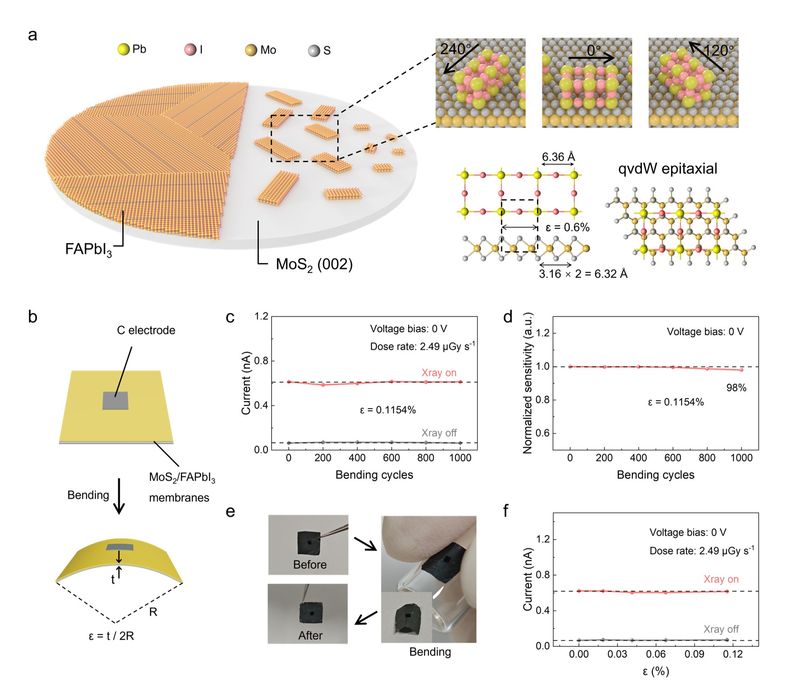
challenge, the team used flexible MoS₂ single crystals as substrates to
epitaxially grow triangular-textured FAPbI₃ perovskite films through quasi-van
der Waals epitaxy. The perovskite grains were aligned along three equivalent
in-plane directions and exhibited well-defined in-plane and out-of-plane
crystallographic orientations.
By exploiting
the band alignment of the MoS₂/FAPbI₃ heterostructure, the team fabricated an
X-ray detector that achieved a sensitivity of 23,145 μC Gy⁻¹ cm⁻² and a
detection limit as low as 177 nGy s⁻¹ at zero bias. The device maintained
stable detection performance after 1,000 bending cycles and retained
approximately 99.8% of its initial sensitivity after 100 hours of storage under
ambient conditions. These results demonstrated its flexibility, mechanical
durability and stability.
By combining
ultrathin, flexible single-crystal materials, perovskite epitaxy and
heterojunction interface engineering, this study provides a new approach to
designing lightweight, flexible radiation detectors with high performance. It
may also inform the development of wearable medical devices and flexible
radiation imaging systems.
Master’s student
Xiaomeng Zhao and PhD candidates Zhanpeng Wei and Yalu Li are the co-first
authors of the paper. Professors Shuang Yang, Huagui Yang, and Yu Hou are the
corresponding authors. All six authors are from the School of Materials Science
and Engineering at ECUST.
The research was
supported by the Scientific Research Innovation Capability Support Project for
Young Faculty, the National Natural Science Foundation of China, and the
Shanghai Pilot Program for Basic Research.